---blog Title---
A Step-by-Step Guide to Audit your Martech Stack
---desktop---

---mobile---

Introduction
Marketing today runs on technology. From tracking customer behavior to managing campaigns, businesses rely on a collection of tools to drive results and make smarter decisions. But just having these tools isn’t enough. To get the best out of your marketing technology, you need regular audits. The catch? Most audits aren’t nearly as effective as they should be.
Despite spending on Martech increasing significantly—from $15.3 billion in 2020 to $23.6 billion in 2023—utilization rates have continued to decline, with businesses using only 33% of their Martech capabilities in 2023, compared to 58% in 2020. This disconnect between investment and utilization highlights a critical issue: without a structured framework for evaluating Martech stacks, businesses risk wasting resources and missing opportunities to optimize performance.
All too often, Martech audits are treated as a routine checklist exercise—counting tools, comparing price tags, and moving on. This kind of superficial approach barely scratches the surface. It leaves organizations with bloated systems, disconnected data, and wasted budgets.
There’s a better way. What you need is a structured framework that evaluates your stack across multiple dimensions coupled with a systematic approach to evaluate the performance of each tool individually and its contribution to the overall ecosystem.
Instead of focusing only on what’s in your stack, you look at how everything works together: Are there gaps where critical tools are missing? Are multiple tools doing the same job? Are your systems sharing data smoothly, or are you losing information along the way? From identifying gaps and redundancies to assessing data flow connectivity, this strategic approach enables businesses to make informed decisions about their Martech investments, ensuring a cohesive, efficient, and future-proof stack.
This article will walk you through how to conduct a Martech stack audit that goes beyond the obvious. If you want to uncover inefficiencies, spot opportunities, and make sure your technology is actually working for you, it’s time to rethink how you approach audits. Let's get started.
Understanding the Foundations of a Martech Stack Audit
Before diving into the details of how to audit your Martech stack effectively, it’s important to understand what a Martech stack audit entails and why it’s a critical exercise for your business.
What is a Martech Stack Audit?
A Martech stack audit is a detailed review of the tools and technologies that make up your marketing ecosystem. It’s not just about knowing what tools you have—it’s about understanding how well they’re performing, whether they’re being used to their full potential, and how seamlessly they integrate with one another.
The problem is that many audits stop at simply listing tools or reviewing costs. These check-the-box exercises miss the bigger picture: how your tools drive marketing performance and align with business goals. Without a proper strategy, audits can become a waste of time, leading to bloated systems with overlapping features, poor integration, and untapped opportunities.
Why is a Martech Audit Critical for Business Success?
Every tool in your Martech stack represents an investment—of money, time, and effort. If your tools aren’t delivering value or working well together, that investment quickly becomes a liability. A thorough audit ensures that your stack is lean, efficient, and capable of driving measurable results.
When done right, Martech audits can:
- Reveal inefficiencies, helping you cut costs without sacrificing capabilities.
Many organizations unknowingly pay for tools that are underutilized or entirely redundant. A thorough audit identifies these inefficiencies, enabling you to streamline your stack and reallocate budget to areas that truly impact your goals. For example, consolidating two overlapping tools into a single, multifunctional solution can not only save money but also simplify workflows for your team.
- Highlight gaps where new tools or processes can enhance performance.
The fast pace of marketing technology means new challenges often emerge before existing tools catch up. Audits reveal critical gaps—such as the lack of an attribution model or a tool for real-time data visualization—that hinder your team’s ability to perform at its best. By identifying these gaps, you can proactively address them with the right tools or workflows, enhancing both efficiency and effectiveness. By identifying these gaps, you can proactively address them with tools to integrate your Martech systems, enhancing both efficiency and effectiveness.
- Improve marketing agility, allowing your team to adapt quickly to changes.
In today’s dynamic market, adaptability is key. A lean and well-integrated Martech stack ensures your team can pivot quickly—whether responding to changing customer behaviors, launching a new product, or dealing with external disruptions. Audits highlight bottlenecks in your processes and systems, empowering you to create a more flexible, responsive setup.
- Ensure your data flows seamlessly, empowering better decision-making.
Data is the lifeblood of modern marketing, but disconnected systems and broken integrations can create silos that undermine its value. A comprehensive audit maps your data flow, ensuring that every tool in your stack contributes to a unified view of your customers. Strategically utilizing MarTech ensures smarter decisions, from optimizing campaigns to personalizing customer experiences. At its core, an audit isn’t just about technology. It’s about connecting your Martech stack to tangible business outcomes like better customer experiences, higher ROI, and faster growth.
The Consequences of Getting MarTech Audits Wrong
When audits are rushed or poorly structured, the consequences can be costly. Businesses often miss critical gaps or overlook redundancies, leading to operational inefficiencies and missed opportunities.
For instance, a growing retail brand invested heavily in automation tools to boost customer engagement. But with no clear audit strategy, they ended up with three different tools doing similar jobs. These tools didn’t integrate with their CRM, creating a fragmented customer view and leading to inconsistent messaging. The result? Lost sales, wasted spend, and frustrated customers.
Ad-hoc audits don’t just waste money—they can erode trust with customers and hamper your ability to compete. That’s why a systematic, architectural approach is non-negotiable. Optimizing your technology stack with a structured audit strategy and cadence ensures maximum impact with minimal waste.
A Strategic Audit Framework for Martech Stack Evaluation
To move beyond surface-level audits, you need a clear, structured framework—a way to evaluate your Martech stack across multiple dimensions and uncover deeper insights.
Instead of treating your Martech tools as isolated components, this approach focuses on how they work together to support your marketing strategy. By assessing key dimensions like completeness, redundancies, and data flow connectivity, the model provides a holistic view of your stack, empowering smarter decisions and greater efficiency.
Key Dimensions to Evaluate Your Martech Stack
A martech platforms stack is more than just a collection of tools—it’s the backbone of your marketing operations. To ensure it performs effectively, it must be evaluated from multiple angles. A thorough evaluation not only uncovers inefficiencies but also provides a roadmap for enhancing your tools, processes, and integrations.
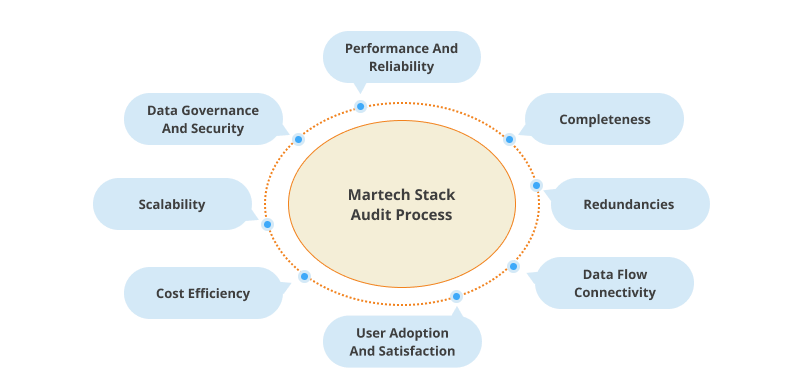
Here are the key dimensions every Martech audit should address:
- Completeness: Does your stack cover all critical marketing functions? Evaluate whether essential capabilities—such as customer data management, analytics, campaign automation, and content delivery—are fully supported. Missing functionality can lead to inefficiencies and missed opportunities. Consider Implementing MarTech Solutions in these vital areas.
- Redundancies: Are multiple tools in your stack performing the same task? Redundant tools increase costs, create unnecessary complexity, and confuse teams. Identifying overlaps helps streamline your operations and ensures each tool serves a distinct purpose.
- Data Flow Connectivity: How well do your tools integrate with one another? Disconnected systems result in siloed data, making it difficult to achieve a unified customer view or automate processes. Evaluate data flow between tools to ensure seamless communication and real-time insights. Integrating Martech Systems is key to achieving a cohesive and efficient ecosystem.
- User Adoption and Satisfaction: Are your teams effectively using the tools in your stack? Low adoption rates or negative feedback often indicate tools that are overly complex, irrelevant, or poorly integrated into workflows. A successful stack isn’t just about technology; it’s about usability.
- Cost Efficiency: Is your Martech stack delivering value for its cost? Beyond licensing fees, consider hidden expenses like training, maintenance, and underutilized features. Evaluating the return on investment for each tool helps you maximize your budget.
- Scalability: Can your stack grow with your business? A scalable Martech stack is one that supports increased data volume, new marketing channels, and expanding team needs without requiring disruptive changes or major investments.
- Data Governance and Security: Are your tools compliant with regulations like GDPR or CCPA? Evaluate your stack for robust data protection measures, consent management capabilities, and other compliance features. Secure systems reduce legal risks and build customer trust.
- Performance and Reliability: Are your tools meeting expectations in terms of uptime, speed, and reliability? Tools that frequently crash or underperform can disrupt operations and erode team confidence. A dependable Martech stack is crucial for consistent marketing execution.
- Alignment with Business Goals: Does your stack align with your broader marketing and business objectives? Every tool should contribute directly to achieving key outcomes such as customer acquisition, retention, or brand growth. Misaligned tools drain resources and dilute focus.
- Customer Experience Impact: Does your stack enable seamless and personalized customer interactions? Evaluate how well your tools support consistent messaging, timely engagement, and tailored experiences across all touchpoints.
By examining your Martech stack through these dimensions, you create a clear picture of its strengths and weaknesses. This holistic evaluation ensures that your stack is not only efficient and cost-effective but also primed to meet your business goals today and in the future.
Key Steps to Conducting a Martech Stack Audit
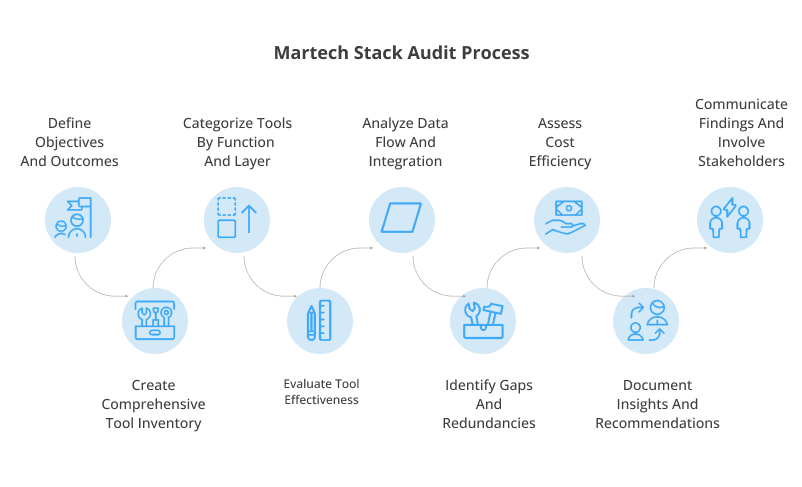
Conducting a Martech stack audit without a framework is like navigating without a map—you might make some progress, but chances are you’ll miss critical insights or take longer than necessary to reach your destination. A structured framework provides a clear, step-by-step process that ensures no aspect of your Martech stack goes unnoticed. Here’s how to organize your audit for maximum effectiveness:
1. Define Objectives and Outcomes
Start by clarifying what you want to achieve with the audit. Are you aiming to cut costs, enhance efficiency, improve data flow, or identify gaps? Align these objectives with broader business goals, such as boosting customer acquisition, increasing ROI, or improving customer experience. Setting clear objectives ensures the audit remains focused and actionable.
- Identify Objectives: Are you looking to reduce costs, improve data flow, eliminate redundancies, or align your stack with new business goals?
- Set Metrics: Establish measurable criteria to evaluate your stack’s performance, such as tool usage rates, integration success rates, or ROI.
- Align with Business Goals: Ensure your audit objectives support broader company priorities, such as customer acquisition, retention, or brand growth.
2. Create a Comprehensive Tool Inventory
Create a comprehensive inventory of all tools currently in use. This will serve as the foundation for your audit. Document every tool in your Martech stack, including:
- Tool name and purpose
- Licensing costs and terms
- Users or teams responsible for each tool
- Current usage level (e.g., active, underused, or unused)
- Integration status with other tools
3. Categorize Tools by Function and Layer
To effectively audit and optimize your Martech stack, it's essential to categorize tools based on their function and role within your marketing operations.
Here’s a framework that we adopt for to structure the Martech stack into distinct layers, each encompassing specific categories of tools. These layers cover the entire spectrum of digital function including data, analytics, technology, campaign, content, experience, and commerce.
Data Layer
This foundational layer supports data collection, organization, and storage across various sources, enabling insights and operations at scale.
-
Data Management Platforms (DMP): Collect and organize data for advertising and audience segmentation.
- Examples: Lotame, Oracle BlueKai.
-
Customer Data Platforms (CDP): Create unified customer profiles by integrating data from multiple touchpoints.
- Examples: Segment, Tealium.
-
Data Warehousing: Store and process large data sets for analytics and reporting—often compared with CDPs in terms of functionality and purpose. Understanding cdp vs data warehouse helps determine which one best suits your marketing data strategy.
- Examples: Amazon Redshift, Snowflake.
-
Data Lakes: Manage unstructured and structured data for advanced analytics.
- Examples: Microsoft Azure Data Lake, Google Cloud Storage.
Intelligence Layer
This layer focuses on deriving insights, measuring performance, and forecasting trends.
-
Digital Measurement Cloud:
-
Tag Management Systems (TMS): Centralize and manage marketing tags for tracking and analytics.
- Examples: Google Tag Manager, Adobe Launch.
-
Digital Analytics Platforms: Track and analyze user behavior on websites and apps.
- Examples: Adobe Analytics, Google Analytics.
-
Attribution Platforms: Evaluate the impact of marketing channels on conversions.
- Examples: Attribution, Nielsen Attribution.
-
Customer Experience Analytics: Measure and optimize user interactions and satisfaction.
- Examples: Qualtrics, Medallia.
-
-
nalytics:
-
Data Analytics: Aggregate and analyze data for decision-making.
- Examples: Tableau, Power BI.
-
Predictive Analytics: Use historical data to predict future customer behavior or outcomes.
- Examples: IBM SPSS, RapidMiner.
-
AI & Machine Learning: Automate insights and decision-making using advanced models.
- Examples: DataRobot, H2O.ai.
-
-
Reporting:
-
Business Intelligence Platforms: Provide actionable insights through dashboards and reports.
- Examples: Qlik, Microsoft Power BI.
-
Data Visualization Tools: Transform complex data into accessible visual formats.
- Examples: Looker, Domo.
-
Engagement Layer
The engagement layer delivers interactions, campaigns, and targeted experiences to customers.
-
Digital Experience:
-
Personalization Platforms: Tailor content and user experiences based on behavior and preferences.
- Examples: Dynamic Yield, Optimizely.
-
CMS/DXP (Content Management Systems/Digital Experience Platforms): Manage and deliver digital content across channels.
- Examples: WordPress, Adobe Experience Manager.
-
DAM (Digital Asset Management): Store and organize digital assets like images and videos.
- Examples: Bynder, Widen Collective.
-
Experimentation Tools: Test and optimize variations of digital experiences.
- Examples: Google Optimize, VWO.
-
Commerce Platforms: Enable e-commerce functionality, including payments and product catalogs.
- Examples: Shopify, Adobe Commerce.
-
Customer Feedback and Survey Tools: Collect and analyze customer feedback for improvements.
- Examples: SurveyMonkey, Qualtrics.
-
-
1:1 Targeting:
-
Marketing Resource Management (MRM): Plan, budget, and manage marketing resources.
- Examples: Aprimo, Wrike.
-
Campaign Planning: Strategize and execute marketing campaigns.
- Examples: Workfront, Smartsheet.
-
Journey Management: Map and optimize customer journeys across touchpoints. Platforms like salesforce marketing cloud service help orchestrate personalized journeys at scale using real-time data and automation.
- Examples: Thunderhead, Salesforce Journey Builder.
-
Campaign Management: Oversee and automate campaign execution.
- Examples: Marketo, Pardot, HCL Unica
-
CRM and Lead Management: Manage customer relationships and track leads. Tools like Salesforce also offer powerful salesforce automation capabilities to streamline workflows, lead nurturing, and customer engagement.
- Examples: Salesforce, HubSpot CRM.
-
Loyalty Management: Build and reward customer loyalty.
- Examples: Annex Cloud, Smile.io.
-
-
Infrastructure Layer:
The infrastructure layer is the backbone of your Martech stack, providing the necessary technical foundation for data storage, integrations, and security.
-
Cloud Services: Provide scalable computing resources and storage.
- Examples: Amazon Web Services (AWS), Microsoft Azure.
-
Integration Platforms: Connect disparate systems and facilitate data flow between them.
- Examples: MuleSoft, Zapier.
-
Security and Compliance Tools: Ensure data protection and regulatory compliance.
- Examples: OneTrust, TrustArc.
-
Infrastructure Layer:
The infrastructure layer is the backbone of your Martech stack, providing the necessary technical foundation for data storage, integrations, and security.
-
Cloud Services: Provide scalable computing resources and storage.
- Examples: Amazon Web Services (AWS), Microsoft Azure.
-
Integration Platforms: Connect disparate systems and facilitate data flow between them.
- Examples: MuleSoft, Zapier.
-
Security and Compliance Tools: Ensure data protection and regulatory compliance.
- Examples: OneTrust, TrustArc.
Channels Layer
The Channels Layer is where engagement meets execution. It includes tools that manage communication and distribution across various touchpoints and platforms.
-
Owned Channels
-
Email Marketing: Tools for creating, managing, and tracking email campaigns.
- Examples: Mailchimp, Campaign Monitor.
-
Mobile Apps: Tools to manage and engage users on mobile platforms.
- Examples: Firebase, Braze.
-
Customer Support and Chatbots: Platforms that provide customer service and automate responses to common inquiries.
- Examples: Zendesk, Intercom
-
Content Publishing Tools: Platforms for managing blogs, articles, videos, and other owned content.
- Examples: Wistia, Vidyard, Contently.
-
-
Paid Channels
-
Search Engine Marketing (SEM): Manage paid search campaigns on platforms like Google and Bing.
- Examples: Google Ads, Microsoft Advertising.
-
Social Media Advertising: Tools to run and optimize paid campaigns on social platforms.
- Examples: Facebook Ads Manager, LinkedIn Marketing Solutions.
-
Display and Programmatic Advertising: Platforms for automated ad buying and placement.
- Examples: The Trade Desk, DoubleClick.
-
-
Earned Channels
-
Social Media Management: Manage organic social media activities and monitor mentions.
- Examples: Hootsuite, Sprout Social.
-
PR and Media Relations: Tools for managing press releases, media contacts, and coverage.
- Examples: Cision, Meltwater.
-
Influencer Marketing: Platforms to connect with and manage influencer partnerships.
- Examples: Aspire, Upfluence.
-
Affiliate and Partner Marketing: Tools that manage relationships and track performance with affiliates and partners.
- Examples: PartnerStack, Impact.
-
By categorizing your Martech tools within this layered framework, you can gain a clearer understanding of your current capabilities, identify areas for improvement, and ensure a cohesive and efficient marketing technology ecosystem.
4. Evaluate Tool Effectiveness
Assess each tool for its effectiveness, relevance, and performance:
- Effectiveness: Does the tool meet your team’s needs and deliver measurable results?
- Relevance: Is the tool still aligned with your current marketing goals?
- Performance: Are there any technical issues, like frequent downtime or slow performance?
- User Feedback: Gather input from the teams using the tools to understand their experiences, challenges, and satisfaction.
5. Analyze Data Flow and Integration
A well-connected Martech stack ensures smooth data transfer, enabling real-time decision-making and accurate reporting.Map how data moves through your stack. Identify integration points between tools and evaluate whether the data flow is seamless. Look for issues such as:
- Create a Data Flow Diagram: Map integrations between tools and identify bottlenecks or disconnects.
- Check for Data Silos: Look for tools that don’t share data effectively, creating isolated insights.
- Evaluate Integration Tools: Assess whether integration platforms (e.g., Zapier, MuleSoft) are being used effectively to connect systems or require other means of integration for compatibility.
6. Identify Gaps and Redundancies
Use your inventory and evaluation findings to pinpoint where your stack is falling short or duplicating effort.
- Gaps: Identify missing capabilities that are critical to achieving your marketing objectives, such as predictive analytics or cross-channel reporting.
- Redundancies: Highlight overlapping tools performing similar functions, leading to wasted budget and complexity.
For each gap or redundancy, determine the business impact and prioritize actions to address them.
7. Assess Cost Efficiency
Evaluate whether your stack is delivering value relative to its cost.
- Review Licensing Fees: Compare each tool’s cost against its usage and ROI.
- Account for Hidden Costs: Factor in maintenance, training, and support expenses.
- Benchmark Against Alternatives: Research other tools to see if better options are available at lower costs.
This analysis helps you make informed decisions about which tools to keep, upgrade, or replace.
8. Document Insights and Recommendations
Compile your findings into a detailed report that includes:
- Strengths and weaknesses of your current stack
- Specific gaps and redundancies identified
- Data flow and integration challenges
- Recommendations for optimization, such as consolidating tools, introducing new capabilities, or renegotiating vendor contracts
This document serves as a blueprint for improving your stack and ensuring alignment with business goals.
9. Prioritize and Plan Actions
Based on your recommendations, create an action plan with prioritized steps. Focus on high-impact changes first, such as eliminating costly redundancies or resolving critical data integration issues.
- Prioritize by Business Impact: Address gaps and redundancies that have the greatest effect on performance or cost savings.
- Create a Timeline: Develop a phased plan to implement changes, such as integrating tools, replacing redundant systems, or adding new capabilities.
10. Communicate Findings and Involve Stakeholders
Share your audit findings with key stakeholders across departments. Collaboration ensures buy-in for proposed changes and helps align the stack with broader organizational needs.
- Use Visual Aids: Present findings through diagrams, charts, and dashboards for clarity.
- Highlight ROI Opportunities: Emphasize cost savings, efficiency gains, and performance improvements to secure buy-in.
- Encourage Collaboration: Involve cross-functional teams in implementing the recommendations to ensure alignment.
By following these steps, you can conduct a Martech stack audit that goes beyond surface-level observations and delivers actionable insights. The result is a leaner, smarter, and more effective Martech ecosystem that aligns with your business goals.
Common Pitfalls in Martech Audit Assessment and How to Avoid Them
A Martech stack audit is a vital process for ensuring your tools work effectively and align with business goals. However, without careful planning and execution, it’s easy to fall into common traps that can derail the process and limit its impact. Understanding these pitfalls and proactively addressing them can make the difference between a superficial audit and one that delivers lasting value.
1. Failing to Align with Organizational Priorities
One of the most significant challenges is failing to align the audit with organizational priorities. Martech stacks don’t operate in isolation—they serve multiple teams, from marketing and sales to customer service and IT. Overlooking input from these stakeholders often leads to an incomplete picture, where key requirements are missed, and tools that are critical to one department are undervalued or eliminated. The solution often starts with involving a skilled martech consultant who can guide cross-functional teams and ensure alignment with broader organizational goals.
2. Overlooking Data Security and Compliance
Data security and compliance is another critical area that is often neglected. With increasing regulatory scrutiny from laws like GDPR and CCPA, failing to address compliance risks can result in hefty fines and reputational damage. Yet, many audits focus solely on performance metrics, leaving gaps in data protection unchecked. A comprehensive approach must also evaluate how MarTech technology platforms handle sensitive data while ensuring adherence to compliance standards.
3. Rushing Through the Audit Process
Rushing through the audit process is another common mistake. In the drive to quickly identify inefficiencies or save costs, organizations often skip crucial steps, leading to shallow insights and incomplete findings. A successful audit requires realistic timelines, allowing for detailed tool evaluations, stakeholder consultations, and iterative analysis. Rushed audits might miss opportunities to address deeper issues, such as poor data integration or gaps in functionality.
4. Focusing Solely on Cost-Cutting
Cost-cutting can also become a double-edged sword in Martech audits. While reducing expenses is often a primary goal, focusing solely on costs can result in short-sighted decisions, such as removing tools that offer long-term strategic value. For instance, eliminating a high-cost tool without considering its unique capabilities could lead to lost opportunities in customer engagement or analytics. A balanced approach evaluates each tool's ROI, considering both direct financial benefits and intangible advantages like improved workflows or enhanced customer experiences. For instance, instead of eliminating tools outright, consider strategies for optimizing your technology stack to achieve cost efficiency without sacrificing capabilities.
5. Ignoring Integration and Data Flow
Integration and data flow issues are another area that’s frequently overlooked. A stack full of powerful tools is of little use if they don’t work together effectively. Disconnected systems and data silos hinder collaboration, slow down decision-making, and lead to inefficiencies. Audits should prioritize mapping the flow of data between tools, identifying bottlenecks, and evaluating whether integration platforms are being utilized effectively.
6. Focusing Only on Immediate Needs
Planning only for the present, rather than the future, is another pitfall. Many audits focus on solving immediate problems without considering scalability or long-term business needs. As organizations grow, their Martech stacks must adapt to new channels, higher data volumes, and evolving customer expectations. Audits must assess the scalability of tools and ensure they align with future marketing and business strategies.
7. Underestimating the Importance of User Adoption
Lastly, user adoption is a critical yet often underestimated factor in Martech success. Even the most feature-rich tools are ineffective if teams find them cumbersome or irrelevant. Low adoption rates often point to a lack of training, poor tool alignment with workflows, or overly complex systems. Including user feedback as part of the audit process ensures these issues are identified and addressed, whether through additional training, simplification, or tool replacement.
By approaching your Martech stack audit with these challenges in mind, you can create a process that is thorough, thoughtful, and aligned with your organization’s goals. Avoiding these pitfalls ensures that your audit delivers actionable insights, helping you build a streamlined and effective Martech ecosystem.
Building a Future-Proof Martech Stack
Once your Martech stack audit is complete, the next step is to use your findings to create a Martech ecosystem that is not only optimized for today but prepared to adapt to future challenges and opportunities. A future-proof Martech stack is one that is scalable, flexible, and continuously evolving to support your organization’s goals.
Designing for Scalability and Flexibility
As marketing strategies evolve and the lines between advertising and marketing tech blur, understanding adtech vs martech becomes essential to building a stack that is both scalable and purpose-built.
To stay ahead, your Martech stack must be designed to grow and evolve alongside these changes.
Start by evaluating your current tools for scalability. Can your platforms handle increased data volumes as your business grows? Are they equipped to support new channels, devices, or customer touchpoints? If not, prioritize tools and vendors with scalable solutions, such as cloud-based platforms that can expand with your needs.
Flexibility is just as important. Rigid tools that don’t integrate easily or adapt to new workflows can become bottlenecks over time. Look for platforms with open APIs, robust integration capabilities, and a proven track record of adapting to technological advancements. Additionally, exploring Martech stack optimization can help uncover redundancies, improve integrations, and enhance the ROI of your tools.
Leveraging Insights for Continuous Optimization
Your Martech stack should never be static. The audit process is just the starting point for continuous improvement. Use the insights from your audit to refine your stack and establish processes for regular optimization.
Implement a feedback loop to ensure tools remain aligned with your organization’s evolving needs. Collect input from users on tool effectiveness and challenges. Regularly monitor KPIs such as ROI, usage rates, and data quality to identify areas for improvement.
Additionally, invest in training to maximize tool adoption and efficiency. Ensure your teams understand how to use each platform effectively and are aware of any new features or updates that could enhance their workflows. Implementing a MarTech utilization strategy can ensure your stack remains aligned with business goals and evolving market demands.
Creating an Audit Cadence
Future-proofing your Martech stack requires an ongoing commitment to evaluation and adjustment. A single audit provides valuable insights, but regular evaluations of your Martech tools are essential to maintaining an optimized and aligned stack.
Establish a formal audit cadence, such as annually or bi-annually, to ensure your stack continues to support your business goals. Each audit should build on the findings of the previous one, tracking progress on action items and identifying new opportunities for improvement.
In addition to full audits, consider implementing quarterly reviews of key metrics, such as tool adoption rates, integration effectiveness, and data quality. These mini-assessments can help you stay ahead of potential issues and maintain the momentum of your optimization efforts.
Conclusion: Moving Beyond the Box-Ticking Exercise
A Martech stack audit, when done right, is far more than a routine checklist or a one-time exercise. It’s a strategic opportunity to uncover inefficiencies, optimize resources, and align your marketing technology with your business goals. By approaching your audit with a structured framework and a focus on key dimensions—such as tool effectiveness, data flow, user adoption, and compliance—you can transform your Martech stack into a streamlined, high-performing ecosystem.
Too often, Martech audits are reduced to cataloging tools and cutting costs without considering the bigger picture. This limited perspective can lead to missed opportunities, fragmented customer experiences, and stagnation in your marketing capabilities. Instead, by leveraging an architectural framework, you can evaluate your stack holistically, identifying gaps, redundancies, and integration challenges that may be holding your organization back.
The journey doesn’t end with the audit. Building a future-proof Martech stack requires continuous optimization, regular evaluations, and a commitment to staying ahead of technological and market changes. By creating an audit cadence and fostering a culture of continuous improvement, your organization can ensure its marketing technology adapts to new challenges and drives long-term growth.
The time to act is now. Begin your Martech audit with purpose and strategy, and transform your technology investments into a powerful engine for business success. Start with this framework, and take the first step toward unlocking the full potential of your Martech stack today.
---Outlined-cta---
Looking for MarTech Consulting? We help you streamline MarTech tools, maximize ROI, and uncover hidden redundancies.
---Interests---
You may also be interested in

Thought Leadership
Are Predictive Models Still Relevant in the Age of Campaigns, Journeys, and Nudges?

POV
Tracking Metrics in Adobe Analytics: A Strategic Guide

Thought Leadership
Digital Analytics Audit: Steps to Perform a Digital Analytics Audit for Business Growth