How to Leverage an E-commerce CDP to Boost Customer Retention and Lifetime Value

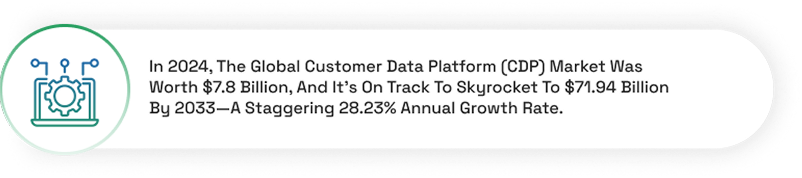
Because businesses are realizing that data isn’t just a resource; it’s the fuel driving hyper-personalized experiences, better marketing efficiency, and stronger customer loyalty.
The verdict: E-commerce brands that don’t harness customer data effectively risk being left behind.
Choose the Right CDP for Your Business. [Free Download] Get your step-by-step guide now!What is CDP for E-Commerce?
E-commerce has evolved beyond simple transactions. It’s now about delivering hyper-personalized experiences that drive customer retention and lifetime value.
A Customer Data Platform (CDP) is the backbone of this transformation, enabling brands to centralize, analyze, and act on customer data in real time.
With a CDP, e-commerce brands can:
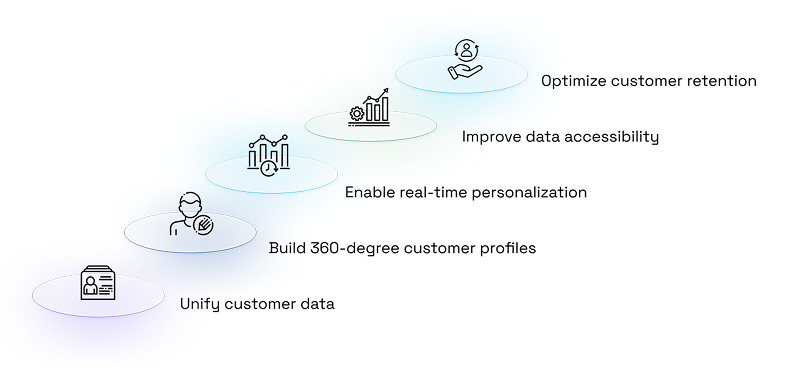
- Unify customer data from multiple touchpoints (website, mobile app, social media, customer support, etc.).
- Build 360-degree customer profiles to understand behavior, preferences, and purchase intent.
- Enable real-time personalization, tailoring marketing efforts based on actual customer interactions.
- Improve data accessibility, ensuring marketing, sales, and customer support teams work with the same data set.
- Optimize customer retention, using predictive analytics and segmentation to drive loyalty strategies.
How an E-Commerce CDP Differs from CRM, DMP, and Other Marketing Tools
The term "customer data" is often used interchangeably across multiple platforms, but not all data management tools are created equal. Understanding the distinction is critical to choosing the right solution for your e-commerce business.
| Platform | Primary Purpose | Key Differentiator |
|---|---|---|
| CDP | Unifies and activates first-party customer data across channels | Focuses on individual customer profiles and real-time insights |
| CRM | Manages customer relationships and interactions | Primarily sales-focused, tracking leads and transactions |
| DMP | Collects and segments anonymous user data for advertising | Built for third-party data and audience targeting, rather than customer insights |
| Marketing Automation | Executes marketing campaigns across email, SMS, and digital ads | Relies on existing data rather than building unified customer profiles |
Unlike CRMs and DMPs, a CDP is designed to centralize all customer interactions—not just sales data or anonymous audience segments. This makes it an essential tool for e-commerce businesses looking to improve customer engagement and marketing ROI.
The Growing Importance of E-Commerce Customer Data in a Privacy-First Era
Regulatory changes and increasing consumer awareness around data privacy have made first-party data more valuable than ever. With third-party cookies disappearing and stricter compliance requirements (GDPR, CCPA, etc.), businesses must rethink how they collect, store, and leverage customer data.
CDPs empower e-commerce brands to:
- Own their customer data, reducing reliance on third-party platforms.
- Enhance data security and compliance, ensuring customer trust.
- Deliver personalized experiences without violating privacy norms.
- Improve advertising efficiency, using first-party insights for better audience targeting.
How Does an E-Commerce CDP Work?
Imagine a bustling marketplace where every merchant knows your name, your preferences, and exactly what you're looking for. Achieving this level of personalized service is not only possible but essential for e-commerce success.
At the heart of this transformation lies the Customer Data Platform (CDP), a powerful engine that collects, unifies, and activates customer data to drive personalized experiences.
The Engine Behind E-Commerce Data Integration
A CDP serves as the central hub in an e-commerce ecosystem, seamlessly integrating data from various touchpoints.
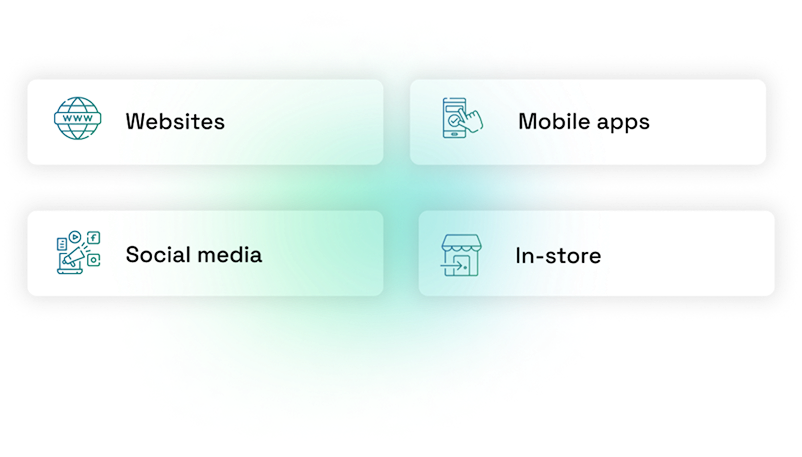
By consolidating this information, it creates a unified customer profile, enabling businesses to understand and anticipate customer needs with unprecedented accuracy.
This level of integration enables businesses to:
- Track customer journeys across multiple touchpoints.
- Identify behavioral trends and purchasing patterns.
- Optimize marketing strategies with real-time insights.
- Enhance personalization by delivering relevant content and product recommendations.

First-Party Data: The Key to Effective Strategies
First-party data, information collected directly from customers, has become invaluable. Leveraging this data allows e-commerce platforms to craft personalized marketing strategies, enhance customer engagement, and build lasting relationships.

By effectively utilizing first-party data, businesses can:
- Create hyper-personalized marketing campaigns that resonate with individual customers.
- Increase customer engagement and retention through tailored offers and loyalty programs.
- Enhance email marketing effectiveness by sending relevant, behavior-driven messages.
- Improve customer segmentation for better targeting in ad campaigns.
The Power of AI in Predictive Personalization
Integrating Artificial Intelligence (AI) with a CDP elevates personalization to new heights. AI analyzes customer behavior patterns and predicts future actions, enabling businesses to offer tailored product recommendations and personalized shopping experiences.
This approach has proven effective, with AI-powered personalization leading to a 15-20% increase in conversion rates.
Embracing a CDP enriched with AI capabilities not only enhances customer satisfaction but also drives revenue growth, positioning businesses at the forefront of the competitive e-commerce landscape
Choosing the Right E-Commerce CDP. Must-Have Features to Look for.
Selecting the right Customer Data Platform (CDP) for e-commerce is critical for maximizing customer insights, driving conversions, and ensuring long-term retention.
Not all CDPs are created equal. To stay competitive, businesses need a platform that offers real-time processing, identity resolution, strong security measures, and AI-driven segmentation.
Here are the must-have features to look for in an e-commerce CDP:
1. Real-Time Data Processing: A Non-Negotiable Requirement
E-commerce moves fast, and real-time customer data is essential for personalized experiences. The best CDPs ingest, process, and activate data instantaneously, enabling businesses to:
- Deliver dynamic, real-time personalization (e.g., customized product recommendations as customers browse).
- React instantly to customer behavior (e.g., triggering abandoned cart emails within minutes).
- Optimize advertising spend by updating audience segments in real time.
2. Identity Resolution: Building a Single Customer View
Consumers interact with brands across multiple channels—websites, mobile apps, social media, and in-store. A robust identity resolution engine ensures that all these interactions are linked to a unified customer profile. Key benefits include:
- Cross-device tracking to recognize customers whether they use a smartphone, tablet, or desktop.
- Behavioral pattern recognition to segment customers based on real-time intent signals.
- Unified insights across the customer journey for more accurate personalization and predictive analytics.
3. Security, Compliance, and Privacy Considerations
Data privacy regulations such as GDPR, CCPA, and CPRA have made it mandatory for e-commerce brands to handle customer data responsibly. A top-tier CDP should:
- Ensure compliance with evolving global privacy laws.
- Offer data encryption and access controls to prevent unauthorized access.
- Provide built-in consent management to ensure transparent data collection and processing.
4. AI-Driven Segmentation for Precision Targeting
Modern e-commerce CDPs use AI-powered segmentation to group customers dynamically based on:
- Purchase history and browsing behavior.
- Predicted lifetime value (LTV).
- Churn risk scores and engagement levels. This enables highly targeted marketing campaigns, personalized email flows, and predictive retargeting that significantly boost conversions.
5. Seamless Integration with MarTech and AdTech Stacks
A CDP should function as the central nervous system of your marketing and advertising operations. It must integrate seamlessly with CRM systems (Salesforce, HubSpot), marketing automation tools (Klaviyo, Marketo), ad platforms (Google Ads, Meta Ads), and analytics tools (Google Analytics, Mixpanel).
6. Scalability and Flexibility for Growth
E-commerce brands evolve, and so should their CDP. Choosing a scalable solution ensures that the platform can handle increasing data volume as the business grows, support multiple data sources and touchpoints, and adapt to new technologies and channels without requiring a complete overhaul.
When evaluating CDP providers, businesses must prioritize speed, security, AI capabilities, and integration flexibility to build a future-proof customer data strategy.
E-Commerce CDP Strategies to Drive Revenue & Loyalty
By leveraging real-time data, AI-driven insights, and predictive analytics, e-commerce businesses can create seamless shopping experiences tailored to individual customer needs.
This section explores key strategies for utilizing CDPs to maximize both revenue growth and customer retention.
1. How a CDP Fuels Dynamic Customer Journey Mapping
Customer journey mapping is no longer a static process. An E-Commerce CDP (Customer Data Platform) enables brands to build real-time, dynamic customer journeys based on behavioral data, transaction history, and engagement signals.
A CDP consolidates first-party data across channels, allowing businesses to track customer interactions from first touch to post-purchase.
With a CDP, e-commerce brands can automate personalized experiences in real time, adapting messaging and product recommendations based on evolving customer behavior. A CDP ensures seamless customer experiences across web, mobile, email, social media, and even in-store interactions.
2. Using CDP Insights for Cross-Device Tracking and Behavioral Targeting
Customers interact with brands across multiple devices before making a purchase. Traditional analytics tools often struggle to connect these interactions, leading to fragmented experiences.
A CDP solves this issue by providing Identity Resolution, which links user identities across devices and sessions, ensuring a unified view of customer behavior.
Through Behavioral Segmentation, real-time data is used to group customers based on browsing patterns, engagement levels, and past purchases.
Meanwhile, Predictive Engagement leverages AI-powered CDPs to analyze patterns and predict the best time, channel, and message for engagement.
3. Automating Omnichannel Marketing with an E-Commerce CDP
A CDP eliminates siloed marketing efforts by orchestrating data-driven campaigns across multiple channels.
Triggered Campaigns automate personalized messages based on events such as abandoned cart activity, product views, or loyalty milestones. Channel Optimization identifies the most effective channels for each customer and adjusts marketing spend accordingly.
AI-Driven Personalization utilizes machine learning models within a CDP to refine marketing efforts, ensuring hyper-relevant content reaches the right audience.
4. Leveraging Predictive Analytics for Smarter Inventory and Demand Forecasting
Inventory mismanagement leads to lost revenue and poor customer experiences. A CDP-driven predictive analytics approach helps brands:
- Anticipate Demand Trends: Analyze historical sales data and customer preferences to optimize stock levels.
- Reduce Stockouts & Overstocks: By predicting product demand, businesses can maintain optimal inventory levels.
- Personalized Merchandising: Recommends products based on customer buying habits, improving conversion rates and average order value.
How to Select the Best E-Commerce CDP for Your Brand
Choosing the right CDP for e-commerce is a strategic decision that impacts customer engagement, personalization, and revenue growth.
The right platform must align with your business size, data maturity, and marketing ecosystem. Let’s break down the key considerations.
Should You Develop or Purchase a CDP?
E-commerce brands must decide whether to build a custom CDP in-house or invest in a pre-built solution. Each option comes with trade-offs:
- Building In-House:
- Buying a CDP:
For most e-commerce businesses, buying a CDP is the more practical choice. Vendors offer specialized solutions with AI-powered insights, omnichannel integrations, and compliance management, reducing the need for heavy internal development.
How Well Does the CDP Fit Your MarTech Stack?
A Customer Data Platform (CDP) is not a standalone solution. It’s the central intelligence hub that powers marketing, e-commerce, advertising, analytics, and customer service.
But a CDP is only as effective as its ability to seamlessly integrate with the tools you already use.
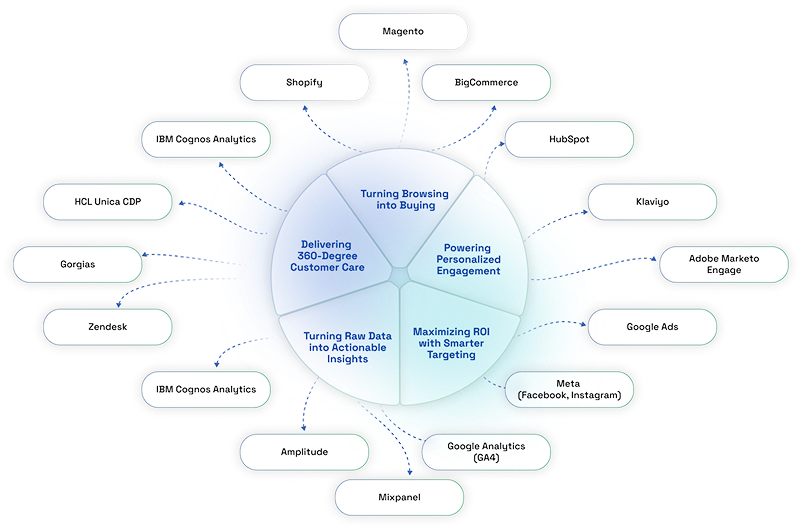
Turning Browsing into Buying
Your e-commerce platform is the heart of customer interactions, so integrating your CDP ensures every click, cart, and conversion feeds into a unified customer profile.
- Shopify: The go-to for DTC brands, Shopify pairs well with Acquia CDP to unify first-party data and enable AI-powered personalization.
- Magento (Adobe Commerce): With deep integration into Adobe Real-Time CDP, Magento enables businesses to track behaviors across devices and deliver real-time recommendations.
- BigCommerce: Enterprises leveraging Salesforce CDP or SAS CDP can unlock next-level segmentation, syncing real-time purchase data with predictive analytics.
Powering Personalized Engagement
Marketing automation tools drive engagement, but without a CDP syncing real-time customer data, brands are shooting in the dark. A well-integrated CDP ensures every email, SMS, and push notification lands at the right moment.
- HubSpot: Works seamlessly with Acoustic CDP (formerly IBM Watson Marketing) to deliver AI-powered, behavior-driven campaigns.
- Klaviyo: Syncs with SAS CDP, ensuring advanced audience segmentation based on real-time behaviors and past purchases.
- Adobe Marketo Engage: Paired with Adobe Real-Time CDP, this powerhouse duo enables brands to automate hyper-relevant messaging based on AI-driven intent signals.
Maximizing ROI with Smarter Targeting
Ad budgets get wasted when campaigns target the wrong audience. A CDP fuels advertising platforms with clean, first-party data, improving targeting precision and reducing ad spend waste.
- Google Ads: Integrated with Salesforce CDP and IBM Watson Advertising, it enables AI-powered audience segmentation and smarter retargeting.
- Meta (Facebook, Instagram): Paired with Adobe Real-Time CDP, it helps brands sync customer data for highly personalized ad delivery.
Turning Raw Data into Actionable Insights
A CDP that integrates with analytics tools transforms data into decision-making power. From tracking attribution to predicting customer behavior, these integrations unlock deeper insights.
- Google Analytics (GA4): When paired with Salesforce CDP and Adobe Analytics, businesses get a comprehensive, real-time view of customer journeys.
- Mixpanel: A favorite for product analytics, it works well with Acquia CDP to track in-app behaviors and refine engagement strategies.
- Amplitude: Integrated with SAS CDP, it enables businesses to analyze customer lifecycles and optimize retention efforts.
- IBM Cognos Analytics: When connected to IBM Watson CDP, it delivers AI-driven recommendations that fuel business growth.
Delivering 360-Degree Customer Care
Customer service is no longer reactive. It’s proactive, personalized, and data-driven when fueled by a well-integrated CDP.
- Zendesk: When synced with Salesforce CDP, support agents gain real-time customer insights for faster, more effective resolutions.
- Gorgias: Paired with Adobe Real-Time CDP, it automates AI-driven responses and prioritizes high-value customers.
- Intercom: Works with Acoustic CDP to deliver chat-based recommendations tailored to a customer’s browsing and purchase history.
- HCL Unica CDP: Ensures AI-powered support experiences, helping brands predict customer issues before they arise.
Budgeting for the Right E-Commerce CDP: What Should You Expect?
CDP costs can range from a few thousand dollars per month for small businesses to hundreds of thousands annually for enterprise-level solutions.
But with various pricing models and feature sets available, choosing the right CDP without overspending or underinvesting can be challenging. Pricing is influenced by several factors, including:
- Data Volume: The number of customer profiles stored and processed
- Feature Set: AI-driven analytics, predictive modeling, segmentation
- Usage Limits: API calls, real-time data processing, activation channels
CDP Cost Breakdown by Business Size
| Business Size | Estimated Cost | Ideal CDP Features |
|---|---|---|
| Small Business (0-50K customers) | $10K–$50K per year (varies depending on requirement) | Basic segmentation, integrations |
| Mid-Sized (50K-500K customers) | $50K–$250K per year (varies depending on requirement) | AI-powered insights, real-time data processing |
| Enterprise (500K+ customers) | $250K+ per year (varies depending on requirement) | Advanced AI, predictive analytics, enterprise security |
For SMBs, a lightweight CDP with core segmentation features might be sufficient, while enterprises require scalable architectures with AI-driven automation.
The best E-Commerce CDP isn’t just feature-rich. It must seamlessly integrate with your existing MarTech stack.
How to Implement a CDP in Your E-Commerce Business
A Customer Data Platform (CDP) is only as valuable as its implementation. Many e-commerce brands invest in a CDP but struggle with integration, data unification, and activation.
This section provides a structured roadmap for successful implementation, highlights common challenges, and outlines key metrics for measuring success.
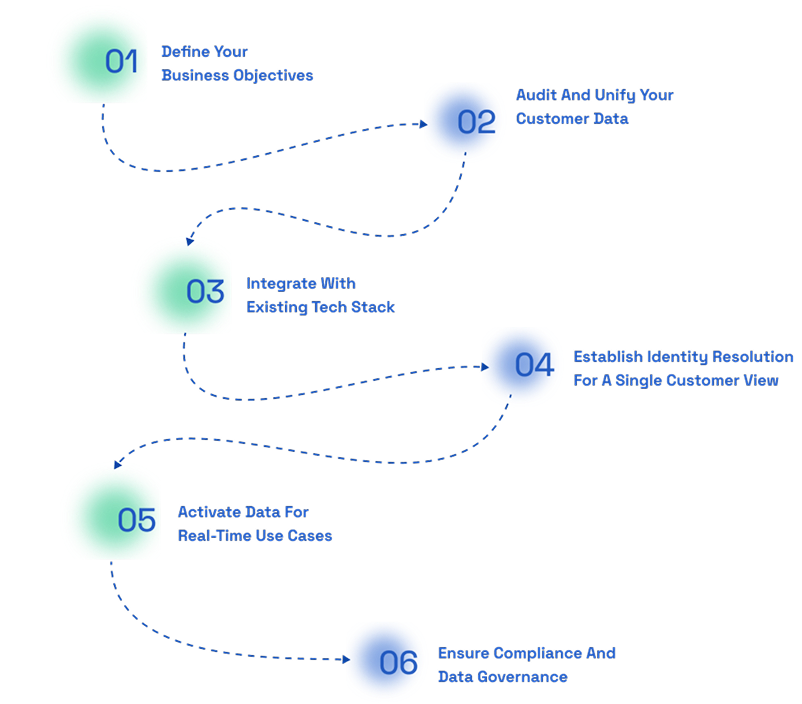
Step 1: Define Your Business Objectives
Before implementing a CDP, determine what success looks like for your e-commerce business.
Are you aiming to enhance personalization, reduce cart abandonment, or optimize marketing spend?
Without clear goals, it’s easy to get lost in data overload. Align CDP capabilities with broader MarTech and customer experience strategies to drive tangible business outcomes.
Step 2: Audit and Unify Your Customer Data
Most e-commerce brands operate with fragmented customer data scattered across multiple platforms:
- Website analytics
- CRM
- Ad networks
- Email marketing tools
- Offline sales
A CDP solves this by centralizing and standardizing data. Start by identifying all first-party data sources, removing duplicates, and ensuring consistency across platforms. Clean data is the foundation of a high-performing CDP.
Step 3: Integrate with Existing Tech Stack
Seamless integration is critical to making your CDP work in real time. API-based integrations allow direct connections with marketing automation tools, personalization engines, and analytics platforms.
Tag-based integrations, such as JavaScript-based event tracking, capture on-site user behavior instantly.
For historical data, batch uploads can help consolidate years of customer interactions. Choosing the right integration method ensures smooth data flow across your ecosystem.
Step 4: Establish Identity Resolution for a Single Customer View
One of the biggest challenges in e-commerce is recognizing customers across multiple devices and sessions.
A CDP uses identity resolution to unify customer profiles, connecting email logins, device fingerprints, and purchase history into a single customer view.
This allows businesses to deliver hyper-personalized experiences without redundant messaging or misalignment between touchpoints.
Step 5: Activate Data for Real-Time Use Cases
Once data is centralized, activation is where the real value begins. A well-configured CDP powers real-time personalization, such as dynamic product recommendations based on browsing behavior.
- Abandoned cart automation becomes more effective by triggering personalized email or SMS reminders.
- Advanced audience segmentation helps target high-value customers with tailored offers, increasing conversion rates.
The key is to ensure your CDP isn’t just collecting data—it’s actively driving measurable engagement.
Step 6: Ensure Compliance and Data Governance
With rising concerns around data privacy, businesses must implement strong governance policies.
Compliance with GDPR, CCPA, and other regulations is non-negotiable. Clear consent management processes should be in place, allowing customers to control their data. Role-based access controls prevent unauthorized use, ensuring data is handled securely across teams.
The Future of E-Commerce CDPs: What’s Next?
As consumer expectations rise and data privacy regulations tighten, businesses must rethink how they collect, process, and activate customer data.
The next generation of CDPs will be more than just data repositories. They will be intelligent, AI-driven engines powering hyper-personalization, predictive analytics, and omnichannel automation.
How AI-Powered E-Commerce Product Data Platforms Are Reshaping Customer Experiences
Traditional CDPs unify and activate customer data, but the future belongs to AI-powered CDPs. These platforms go beyond segmentation by:
- Predicting buying behavior with real-time data modeling
- Delivering personalized recommendations based on historical and in-session interactions
- Optimizing customer journeys dynamically, adapting content and offers on the fly
AI-driven CDPs can detect micro-moments, such as when a customer abandons a cart, and instantly trigger personalized incentives like a limited-time discount or a product recommendation based on past browsing patterns.
The Shift to Predictive Analytics and Hyper-Personalization
E-commerce brands are moving from reactive marketing (responding to customer actions) to predictive marketing (anticipating needs before they arise). This shift is driven by:
- Machine learning models that identify high-intent shoppers
- Behavioral clustering that segments customers based on real-time actions
- Automated A/B testing to optimize content, pricing, and promotions
Brands using predictive analytics see a 15-20% lift in conversion rates compared to rule-based segmentation models (McKinsey, 2024).
What the Cookieless Future Means for CDPs and Privacy-First Marketing
Third-party cookies are disappearing, making first-party data more valuable than ever. CDPs will play a crucial role in:
- Collecting and unifying consented first-party data
- Enabling server-side tracking to comply with privacy laws
- Powering contextual and cohort-based advertising
The future of digital marketing belongs to brands that own and control their customer data. CDPs provide a privacy-first infrastructure, ensuring compliance with GDPR, CCPA, and emerging data regulations.
Traditional vs. Composable CDPs – Which Model Will Dominate?
The future of CDPs is moving toward composable architectures—modular, API-driven platforms that allow brands to select only the components they need. How do they compare?
| Feature | Traditional CDPs | Composable CDPs |
|---|---|---|
| Architecture | Monolithic, all-in-one | Modular, API-first |
| Flexibility | Limited customization | Highly customizable |
| Scalability | Suitable for mid-market | Ideal for enterprise scaling |
| Cost Efficiency | Fixed pricing | Pay-as-you-go model |
Prediction: The rise of composable CDPs will give enterprises more control, agility, and efficiency—making them the preferred choice for scalable, future-proof data strategies.
The e-commerce landscape is more competitive than ever, and customer expectations are at an all-time high. Brands that effectively collect, unify, and activate first-party data gain a decisive edge in personalization, marketing efficiency, and revenue growth.
By leveraging AI-driven segmentation, real-time data processing, and predictive analytics, e-commerce businesses can move beyond generic marketing tactics and deliver highly targeted experiences that drive conversions and loyalty.
From reducing cart abandonment to enabling seamless omnichannel engagement, a well-implemented CDP transforms raw customer data into actionable intelligence.
As the industry shifts toward a cookieless, privacy-first future, CDPs will only grow in importance. Choosing the right platform, integrating it effectively, and continuously optimizing your data strategy will determine which brands lead the next era of digital commerce.

Ashvini SK
Senior Content Writer
Xtelligence Inbox.
Your weekly dose of marketing smarts!
Related Posts




Digital Analytics
Stop Treating Claude Like Just Another Chatbot. Start Using It Strategically.


Digital Analytics
Customer Segmentation: Using Predictive & Adaptive Models for Targeted Marketing