---blog Title---
The Role of AI in Understanding Customer Journey Analytics

Table of Contents
- The transformative impact of AI
- Understanding Customer Journey Mapping with AI
- How AI Helps to Deepen Customer Journey Analysis
- Key Benefits of Combining AI with Customer Journey Mapping
- Identifying Hidden Patterns
- Segmenting To The Core
- Customer sentiment analysis
- Personalization for Every Individual
- Challenges and Considerations
- Common challenges when incorporating AI into CJM
- Key considerations, such as data privacy and ethical implications
- Case Studies and Real-World Examples
- Final Thoughts
The transformative impact of AI
Are you still one of those businesses guessing what your customers want? According to a Salesforce report, 66% of customers expect businesses to understand their unique needs, and 88% demand faster digital initiatives.
Do you have a favorite coffee shop? If you do, it's obvious that they will know all your regular orders.
It gets harder for them to track every customer’s journey when they grow in size. Traditional analytics just can't keep up with all the data needed for deep insights. But AI can!
AI deeply analyzes the data and helps you understand and personalize each customer's experience. It shows patterns and trends with which you can create smooth, personalized customer experiences, just like knowing your regular favorite orders in the coffee shop.
Let us first understand what customer journey analytics (CJA).
In simple It is the process of analyzing customer experience (CX) across all touchpoints. By doing this, you
- Gain a 360-degree view of the entire customer journey towards your brand.
- Have an understanding of the most important touchpoints that lead to higher conversion rates.
- Can identify friction points that affect the customer journey and hinder progress.

Understanding Customer Journey Mapping with AI
Before becoming a customer, the average user interacts with a company across more than 30 channels at least 100 times over a minimum of 3 months. Understanding these users from a 360-degree perspective was tedious before the age of AI.
However, leveraging AI can help you analyze vast amounts of data in a fraction of the time. This data includes website clicks, social media interactions, purchases, and transactions.
The capabilities of AI extend far beyond this, and we'll explore how AI can help you understand customer journey analytics (CJA).
---outlined-cta---
16 TOF strategies to segment e-commerce customers based on transaction frequency. Download Now!
How AI Helps to Deepen Customer Journey Analysis
AI is transforming customer journey mapping by going beyond traditional linear paths, revealing a data-rich map of touchpoints and preferences that drives more personalized experiences. Through AI-powered touchpoints and predictive customer insights, businesses can anticipate needs, refine engagement, and provide a seamless journey for each customer.
By leveraging customer journey machine learning and AI-driven customer experience tools, companies can uncover patterns, predict behaviors, and even automate responses, enhancing every stage of the customer experience.
With real-time customer engagement and predictive targeting solutions, AI helps map every interaction, enabling brands to optimize customer journey analytics and deliver unparalleled personalization. This data-driven approach isn’t just about tracking—it’s about evolving the customer journey and using insights to stay steps ahead in creating experiences that truly resonate.
The Future of Customer Journeys: As AI and machine learning continue to advance, the future holds more refined AI-driven enterprise journeys where hyper-personalization meets seamless engagement, creating connections that last
Key Benefits of Combining AI with Customer Journey Mapping
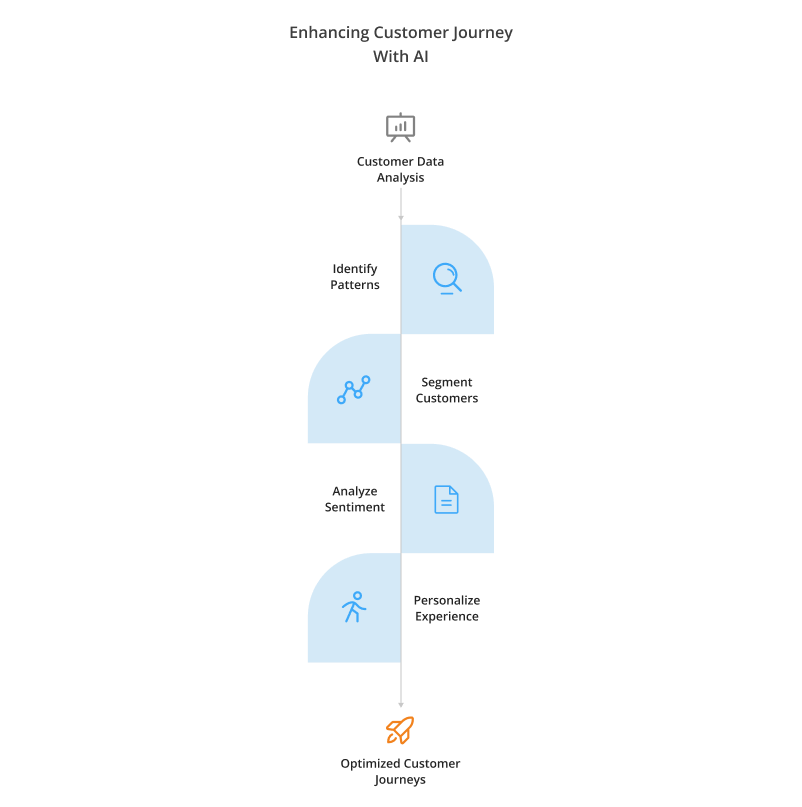
1. Identifying Hidden Patterns
Predictive analysis is considered one of the core uses of AI. It analyzes vast amounts of data and identifies hidden patterns.
AI uses customer data like purchase history, demographics, and online interactions to find hidden patterns that influence customer behavior. These patterns couldn't be identified by humans, but AI can detect correlations between data points that are unrelated.
In this use case simulation, let's see how this can be helpful to a retail company.
What happens if a retail company adopts AI?
It analyzes,
- Historical Sales Data: From past sales data, AI can identify trends and seasonal patterns. With this, businesses can decide which products will likely be in high demand at different times of the year.
- Consumer Behavior: AI can predict future buying patterns of customers by understanding their behavior. For example, it can identify which customers will likely make repeat purchases or will be interested in new product launches.
2. Segmenting To The Core
Segmentation entails grouping similar audiences for the desired targeting. Before AI, segmentation was done based on demographics or basic purchase history. While this approach has been effective, AI has the ability to go beyond these basic methods.
With AI, business understand:
- What, when, and how much customers buy
- Their behavior on the website, on social media, and within apps
- The sentiment analysis from reviews and social media posts
On top of this, AI can also facilitate very granular customer segmentation—with what a customer does rather than just who they are—but also that which includes:
- How they are interacting with your brand
- The kinds of products they are interested in
- New, yet-to-be-loyal; established, and loyal advocates; or perhaps at risk of churning
Use Case Simulation: Advanced Segmentation with AI
Businesses can use AI to create deep segmentation. They can be categorized:
Customers who prioritize comfort and functionality in products/services.
Customers who look for deals and discounts.
Thanks to advanced segmentation, businesses can now understand their customers better. The method also empowers them to create personalized campaigns to meet every segment’s expectations.
3. Customer sentiment analysis
What makes a brand stand out? Anything—product, solution, website—but the key to being the most unique and memorable is through customer experience. For that, a business has to understand the pain points, needs, and opinions of customers and provide feedback and support in no time.
Many big enterprises have made this possible with the help of AI. You might have noticed on X.com how brands address user feedback instantly.
---outlined-cta---
Also Read: 7 Cutting-Edge AI Techniques for Sentiment Analysis - Types, Methods & Approach
Sentiment analysis can be done more deeply and faster with AI. You could do numerous types of sentiment analysis, such as:
- Intent Sentiment: AI will review the reviews or remarks to understand their intent. Like knowing what exactly the customers want. It will then identify intentions based on buying, churning, or upselling.
- Aspect Analysis: AI can further break down the text into more groups and understand the specific aspects of the text related to the brand or business. This aids businesses in understanding what customers expect from their brands or businesses.
- Emotion Analysis: AI can detect and classify the text concerning the emotion and understand the feelings of customers, from joyful, sad, frustrated, etc., towards the brand.
Understanding customer journeys informatively includes their feelings towards the brand.
4. Personalization for Every Individual
The true core of AI lies in its capacity for access to large amounts of data and processing. This is the capability of personalization, considering that it involves a deep understanding of behaviors and customer preferences in driving tailored interactions.
With personalization, every touchpoint now becomes an opportunity. Where traditional personalization would normally stop at basic address customization, AI takes it to the next level beyond just surface interaction.
- Using NLP, AI is able to move beyond the text and Emotion, Intent, and underlying nuances, hence allowing the AI to respond in a very personalized manner—much beyond simple "How can I help you?"
- Product recommendations by Amazon are a fine example of how AI can suggest items based on past behavior. In fact, AI has the potential to do more: it would have already suggested the products rather than simply making reactive recommendations, by anticipating the user's needs and interests.
- Moreover, AI empowers dynamic website personalization. Not loading a static page for each visitor, AI can personalize website content according to user behavior, intention, and needs, and really deliver an offer that is tailored.
From customer behavior understanding to needs understanding, AI empowers organizations to make real personalization possible.
---outlined-cta---
Get Instant Access to the Gen-AI Customer Experience Playbook - Download Now
5. Challenges and Considerations in AI-Driven Customer Journey Mapping
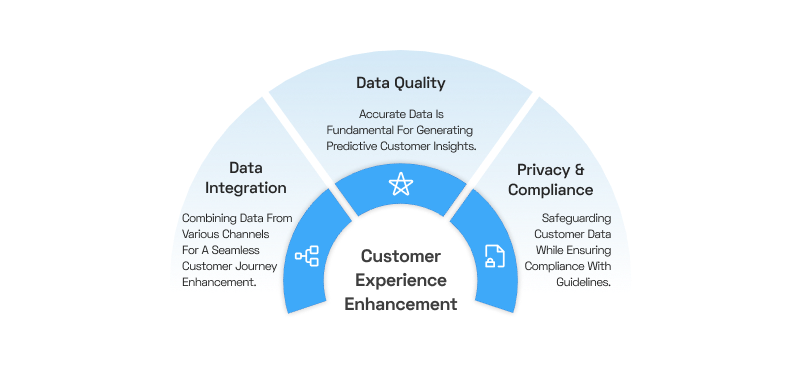
Incorporating AI into customer journey mapping brings challenges such as data quality issues, privacy concerns, and integration complexities. AI-driven customer experience depends on clean, accurate data for predictive insights, and businesses must ensure compliance with data privacy laws like GDPR. Additionally, integrating AI with existing systems for real-time customer engagement requires careful planning.
Key Considerations:
- Data Privacy & Compliance: Adhere to privacy laws (e.g., GDPR) to protect customer information.
- Data Quality & Integration: Ensure clean, up-to-date data and seamless integration with legacy systems for effective customer journey enhancement.
- Ethical AI Deployment: Mitigate AI biases and maintain transparency when using AI-powered touchpoints.
- AI-Driven Personalization: Focus on delivering a personalized customer journey while respecting customer preferences and privacy.
6. Common Challenges When Incorporating AI into Customer Journey Mapping (CJM)
Integrating AI into customer journey mapping presents challenges such as managing complex data integration across multiple touchpoints, ensuring data quality for accurate insights, and addressing privacy concerns, especially with regulations like GDPR.
Additionally, a lack of AI expertise in customer journey analytics can hinder the effective use of data and the optimization of personalized experiences.
7. Key considerations, such as data privacy and ethical implications
Integrating AI into customer journey mapping (CJM) and customer journey intelligence requires addressing key considerations, particularly around data privacy and ethical implications. AI solutions and machine learning for customer journeys rely on sensitive customer data, so businesses must comply with privacy regulations like GDPR and CCPA to protect customer information.
- Data Privacy - Ensure compliance with regulations like GDPR and CCPA to protect sensitive customer data.
- Ethical Implications - Avoid biases in AI models to maintain fairness and transparency in customer experience.
- Data Transparency - Be clear about the data collected and how it is used for AI-powered personalized customer journeys.
- AI Accountability - Use AI responsibly to enhance customer journeys without exploiting personal data or violating ethical standards.
- Compliance Monitoring - Regularly audit AI models to ensure they comply with privacy laws and ethical guidelines.
Case Studies and Real-World Examples
Here are some catchy real-world examples of AI in customer journey mapping:
- Spotify: Powers personalized playlists like “Discover Weekly” using AI and machine learning, boosting engagement and user retention.
- Starbucks: Delivers tailored offers via its app, using AI-powered insights for real-time engagement and increasing loyalty.
- Nike: Leverages AI-driven product recommendations and behavior tracking to optimize the shopping experience and drive sales.
- H&M: Enhances shopping with personalized discounts, fueled by AI for data-driven personalization and smarter inventory management.
- Toyota: Streamlines customer service with AI to improve response time and customer satisfaction through automated interactions.
These brands are turning AI customer journey optimization into a competitive edge!
Final Thoughts
AI has moved way past the buzz—it's now the secret sauce powering business success. Imagine companies sitting on mountains of data, like untapped treasures. AI is the magic key that unlocks this value, transforming raw data into insights that fuel smarter decisions. It dives deep, uncovering each customer’s story and making it possible to connect in ways we never dreamed of. With AI, businesses don’t just see numbers—they see people, journeys, and opportunities to create unforgettable experiences.