---blog Title---
Top 8 CDP Trends to Watch in 2025
---desktop---

---mobile---

Every customer interaction is an opportunity to build stronger relationships — but only if you truly understand your customers. In 2025, fragmented or outdated data isn’t just inefficient; it’s a barrier to growth.
That’s why enterprises are investing heavily in Customer Data Platforms (CDPs). These platforms go beyond being simple data repositories — they act as intelligent engines that unify customer data, power hyper-personalized journeys, and enable real-time activation.
According to Tealium’s 2025 Future of Customer Data Report, 72% of companies are doubling down on first-party data strategies, while 84% leverage real-time CDP activation for better engagement. With the global CDP market projected to hit $10.3B in 2025, the momentum is clear: data-driven personalization is now a competitive necessity.
In this article, we’ll explore the top eight customer data platform trends shaping 2025, giving you a clear roadmap to make your customer data work harder and smarter.
---cta--- Get the [ Free Checklist ] to Modernize Your CDP Effectively Download Now
AI-Powered Customer Data Platforms
AI-powered Customer Data Platforms are revolutionizing how businesses manage and utilize customer information. These platforms go beyond basic data storage and unification by applying artificial intelligence to generate insights, predict customer behavior, and automate decision-making. They also provide the flexibility to integrate CDPs with marketing automation for more targeted campaigns.
Here’s a closer look at how they work and some tools leading the charge.
How AI-Powered CDP Platforms Work
At the core of an AI-driven Customer Data Platform is its ability to analyze data in real time. These platforms collect information from various sources—websites, apps, email, social media, and more—and use machine learning algorithms to identify patterns, trends, and correlations.
- Data Unification: AI ensures that data from multiple touchpoints is accurately consolidated into a single customer profile. It automatically identifies and merges duplicate records, saving time and improving data accuracy.
- Predictive Analytics: The platform leverages historical data to forecast customer behavior, such as when they’re most likely to make a purchase or churn. This helps businesses take proactive steps to retain or convert customers.
- Dynamic Segmentation: Unlike traditional rule-based segmentation, AI dynamically groups customers based on real-time insights, creating more precise audience clusters tailored to current behaviors.
- Automation: AI automates repetitive tasks, such as sending personalized emails or adjusting ad targeting, based on the latest data insights. This ensures timely and relevant communication with minimal manual effort.
These functionalities allow businesses to move from reactive to proactive customer engagement, improving efficiency and driving better outcomes.
Example Tools in AI-Powered CDPs (2025)
In 2025, AI-powered Customer Data Platforms are reshaping how businesses manage, unify, and activate customer data. Here are some leading tools:
- Treasure Data AI Suite – Offers AI copilots and automation features to simplify campaign creation, personalization, and migration from legacy CDPs.
- Segment by Twilio – Uses AI to deliver predictive personalization and behavioral insights for seamless multi-channel journeys.
- Salesforce CDP (Einstein AI) – Combines CRM expertise with AI to enable real-time recommendations, workflow automation, and personalization at scale.
- Amperity – Specializes in identity resolution and predictive analytics, turning fragmented customer data into unified, actionable insights.
- Adobe Experience Platform (Sensei) – Integrates omnichannel data and applies AI to deliver hyper-personalized campaigns and real-time insights.
- Blueshift – Focused on real-time engagement, it uses AI to deliver personalized experiences across email, mobile, and web.
These platforms enable businesses to predict customer intent, activate insights instantly, and deliver personalized experiences at scale, driving higher engagement and ROI.
The Push for Real-Time Data Activation
Enterprises today aren’t just interested in understanding their customers—they want to act on insights instantly. A survey conducted by YouGov revealed that 41% of American consumers feel technology has made them more impatient compared to five years ago, with Millennials feeling this impatience even more strongly at 45%. Real-time responses are no longer a luxury—they are a fundamental expectation. CDPs help enable this shift by integrating seamlessly with MarTech platforms for real-time marketing.
Customers expect businesses to respond to their needs immediately, whether it’s through dynamic website content, personalized offers, or timely support. Customer Data Platforms are evolving to meet these demands, enabling brands to shift from passive data collection to active, on-the-spot engagement.
From Data Storage to Immediate Action
Traditional approaches to customer data focused heavily on collection and storage, with insights often applied long after the fact. Real-time activation flips this model on its head. CDPs now prioritize delivering actionable insights as customer behaviors unfold.
Here’s how it works:
- Immediate Data Processing: As customers interact with a business—be it browsing a website, opening an email, or engaging on social media—the CDP processes this information in real time.
- Trigger-Based Actions: Real-time CDPs use defined rules or AI to trigger actions instantly, such as displaying a discount popup for a product left in a cart or sending a push notification based on recent app activity.
- Agility over Batch Processing: Unlike batch data updates that run periodically, real-time platforms operate continuously, allowing for up-to-the-minute decision-making.
Use Cases Powering Real-Time Engagement
Real-time CDPs open up a world of possibilities for marketers to deliver impactful experiences:
- Dynamic Website Personalization: Websites can adapt to individual users by highlighting relevant products, content, or promotions based on their browsing history or current behavior.
- Live Campaign Adjustments: Marketers can tweak ad campaigns on the fly based on how audiences respond, optimizing ROI as campaigns run.
- Customer Support Enhancements: Chatbots and support teams equipped with real-time insights can provide faster, more relevant responses, improving customer satisfaction.
Companies like Spotify and Amazon have already mastered real-time activation. Spotify curates playlists based on listening habits in the moment, while Amazon adjusts product recommendations as users navigate its site.
Example Tools for Real-Time Data Activation
Here are some of the leading platforms that excel in real-time capabilities:
- Tealium AudienceStream: Known for its robust event-streaming capabilities, Tealium processes customer actions in real time and triggers automated workflows across marketing and support systems.
- mParticle: This platform specializes in unifying customer data and activating it instantly across various tools like email marketing software and analytics platforms.
- Lytics: A composable CDP, Lytics enables real-time audience segmentation and personalization across websites, mobile apps, and other channels.
- Adobe Real-Time CDP: Part of Adobe Experience Cloud, this solution focuses on delivering real-time customer insights and enabling instant personalization across touchpoints.
Real-time activation isn’t just about speed—it’s about creating meaningful, timely interactions that make customers feel seen and valued. Businesses that embrace this approach are better positioned to meet the expectations of today’s on-demand consumers.
---outlined-cta---
Streamline Your CDP Infrastructure with This Free Checklist – Download Now
The Growing Importance of Seamless CDP Integrations
Every business today relies on a mix of tools to manage marketing campaigns, track sales, analyze customer behavior, and handle support. But when these tools don’t talk to each other, customer data becomes fragmented, workflows slow down, and opportunities to connect with customers are missed. That’s why seamless integrations between Customer Data Platforms (CDPs) and other systems are quickly becoming a top priority.
Think of a CDP as the brain of your customer engagement efforts. But a brain is only effective if it can send signals to the rest of the body. Without strong connections to your existing tools—like your email platform, CRM, or analytics dashboard—a CDP is just another data silo.
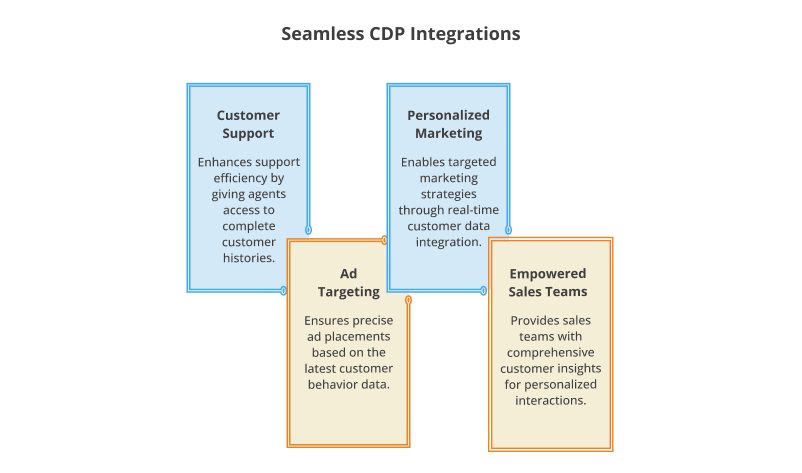
Integrations make it possible for your CDP to power every part of your business:
- Personalized Marketing Made Easy
Picture this: a customer browses your website and leaves without making a purchase. Your CDP detects this behavior and instantly triggers an email, via your marketing tool, offering a discount on the exact product they viewed. Integrating CDP with marketing automation enables personalization at scale. - Empowered Sales Teams
Imagine a sales call where the rep knows everything about the customer’s recent interactions—what emails they opened, what products they’ve looked at, and their purchase history. Integrating MarTech tools such as CRMs make these insights available in real-time, transforming conversations from generic pitches to personalized consultations. - Ad Targeting That Hits the Mark
Your CDP can send real-time data to ad platforms like Google or Facebook, ensuring your ads are targeted based on the most recent customer behavior. For example, someone who browsed winter jackets but didn’t buy might see an ad for those exact products the next time they’re online. - Customer Support with Context
Your support team can resolve issues faster when they have access to a customer’s full history. Integrations with tools like Zendesk allow agents to see every past purchase, complaint, or interaction, reducing frustration for everyone involved.
Data Privacy and Consent Management
With third-party cookies disappearing and data privacy regulations tightening, businesses are under pressure to rethink how they collect and use customer information. First-party data—information directly gathered from your audience—is emerging as the most reliable, ethical, and effective way to drive personalized marketing. Customer Data Platforms are playing a critical role in helping businesses transition to this new reality by collecting, organizing, and activating first-party data at scale.
CDPs protect sensitive customer data directly on your servers, reducing the risk of breaches and ensuring security at the source. When paired with reverse ETL tools, they further enhance data flexibility by automating the flow of insights back into operational systems. This integration promotes seamless collaboration across teams while maintaining strict compliance with privacy standards, enabling secure and efficient data handling.
According to a PwC survey, 72% of consumers are willing to share data with companies they trust, provided there is transparency about how it will be used. A transparent approach includes:
- **Clear Communication:**Explaining what data is collected, why it’s needed, and how it benefits the customer.
- Customer-Controlled Preferences: Allowing users to manage their preferences, opt-out options, and data-sharing settings easily.
- Ethical Practices: Using data responsibly to enhance experiences, not exploit them.
Businesses that adopt these practices build stronger, trust-based relationships that are more likely to result in customer loyalty. For enterprises, this means adopting platforms that not only enhance data security but also integrate with MarTech platforms for seamless marketing to avoid silos.
The Growth of Industry-Specific CDPs
As businesses seek more tailored solutions for their unique challenges, a growing trend is the development of industry-specific Customer Data Platforms. Unlike general-purpose CDPs, these platforms are designed to address the nuances of particular sectors, such as retail, healthcare, financial services, and hospitality. This shift toward specialization is enabling businesses to achieve greater efficiency and return on investment while meeting their industry’s specific demands.
Why Industry-Specific CDPs Are Gaining Popularity
Generic platforms often lack the flexibility to accommodate the distinct workflows, compliance requirements, and customer behaviors unique to certain industries. By contrast, industry-specific CDPs are built with these challenges in mind.
- Compliance Made Easy: In heavily regulated industries like healthcare or finance, CDPs tailored to the sector often come with built-in tools for managing compliance with laws such as HIPAA or PCI DSS.
- Optimized Workflows: These platforms are designed around the industry’s standard processes, reducing the need for extensive customization and making them easier to adopt.
- Targeted Insights: Industry-specific CDPs include analytics and reporting capabilities that align with the key performance indicators most relevant to the sector.
Tools Leading the Industry-Specific Charge
Some CDP providers are making strides in creating platforms tailored to specific industries:
- Healthgrades: Specifically designed for healthcare, Healthgrades’ CDP helps organizations improve patient engagement while maintaining strict data security standards.
- Treasure Data: With customizable templates, Treasure Data serves industries like retail, automotive, and finance, allowing businesses to build solutions that address their unique challenges.
- Zeta Global: Zeta’s retail-focused CDP is built to support omnichannel marketing, enabling real-time personalization for shoppers across digital and physical touchpoints.
The Future of Verticalized CDPs
The rise of industry-specific CDPs signals a shift in how businesses approach customer data. By choosing platforms that cater to their sector, companies can reduce implementation time, improve operational efficiency, and deliver more meaningful customer experiences.
As demand for tailored solutions grows, we’re likely to see more CDPs emerge that specialize in serving niche markets. For businesses, this trend represents an opportunity to adopt platforms that truly align with their goals, helping them stay competitive while addressing the complexities of their industry.
Hybrid CDPs Powered by Cloud Data Platforms
In 2025, a major shift is underway as enterprises increasingly adopt hybrid CDP architectures built directly on top of cloud data platforms like Snowflake, BigQuery, and Databricks. Unlike traditional CDPs that require duplicating data into a separate environment, hybrid CDPs activate insights directly where the data already resides. This eliminates the need for large-scale replication, reduces infrastructure costs, and improves data governance.
How Hybrid CDPs Are Redefining Activation
-
Warehouse-Native Operations
Profiles are unified and managed within the existing data warehouse. Activation happens instantly, with no dependency on bulk data transfers.
-
Real-Time + Historical Context
By combining live event streams with rich historical data, brands can trigger personalized experiences without compromising on scale.
-
Better Compliance and Security
Because customer data stays within secure, governed environments, hybrid models simplify compliance with regulations like GDPR 2.0 and DPDP 2025.
Platforms such as Hightouch, RudderStack, and Snowflake Native CDPs are leading this evolution, giving businesses the flexibility to scale while maintaining full control over sensitive customer data. For enterprises managing large, dynamic datasets, hybrid CDPs are fast becoming the preferred deployment model.
The Shift toward Composability
According to the Customer Data Platform Institute, there are 161 CDP vendors available in the market. This abundance gives data and IT teams plenty of options to choose from—provided they’re content with pre-packaged, fixed solutions. However, 60% of organizations plan to invest in composable enterprise technology within the next three years, according to the 2022 Gartner CIO and Technology Executive Survey.
This signals a shift toward composability, prioritizing a modular architecture in CDPs. Composable Customer Data Platforms are gaining traction as they allow companies to build modular, customizable systems tailored to their unique needs. This trend aligns with the broader push for flexibility, scalability, and efficiency in how businesses manage their customer data and engagement strategies.
---outlined-cta---
Access the Framework Used by Enterprises for CDP Modernization – Download Now
What Are Composable CDPs?
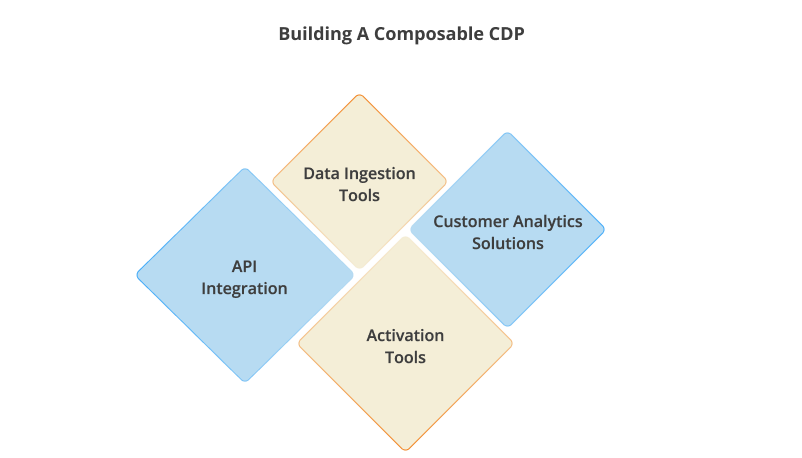
A composable CDP is built from interchangeable components that can be selected, combined, and scaled according to a company’s specific requirements. Instead of relying on a single vendor for an all-in-one solution, businesses can choose best-of-breed tools for individual functions such as data ingestion, processing, segmentation, and activation. These components are connected via APIs, ensuring seamless data flow and functionality.
Key Features of Composable CDPs
- API-First Design: Enables seamless integration between various components and third-party tools.
- Plug-and-Play Architecture: Businesses can easily add or replace components based on evolving needs.
- Vendor Agnosticism: Organizations are not locked into a single vendor, allowing for greater flexibility in choosing the best tools for each task.
- Focus on Data Portability: Ensures that data can move freely and securely between systems, preventing silos.
---outlined-cta---
Get the strategy guide to personalize insurance journeys
Real-World Applications of Composable CDPs
- eCommerce Businesses:
An eCommerce company might combine a best-in-class data ingestion tool like Fivetran with a leading customer analytics solution such as Snowflake and an activation tool like Iterable. Each component excels at its role, creating a highly optimized and agile system. - Media and Entertainment:
Media companies can build a composable CDP to handle massive data volumes, integrating audience segmentation tools like Amplitude with campaign activation platforms for targeted advertising. - Retailers:
A retailer could use a composable CDP to track real-time store and online behavior, combining real-time event processing from a tool like RudderStack with AI-driven personalization engines such as Blueshift.
While the benefits are clear, transitioning to a composable CDP model requires thoughtful planning. When implemented with a strategic approach, composable architectures provide a future-proof approach to managing customer data. For a deeper understanding of how CDPs compare to other systems, exploring the CDP vs DW comparison is crucial for identifying the right solution for your organization's needs.
Augmented Analytics & No-Code CDPs
As CDPs become more sophisticated, data democratization has become a top priority in 2025. Organizations are increasingly adopting augmented analytics and no-code interfaces within CDPs to enable non-technical teams—marketers, analysts, and product managers—to explore, analyze, and activate data independently.
How This Changes the Game
-
Natural Language Insights
Augmented analytics allows users to ask questions in plain language, like “Which customer segments drove the highest revenue last quarter?” The CDP’s AI engine interprets the query and surfaces actionable insights instantly.
-
Drag-and-Drop Journey Building
Marketers can visually design personalized customer journeys using no-code tools—triggering actions based on real-time customer behavior without engineering support.
-
Predictive Decision-Making
By applying machine learning behind the scenes, augmented analytics automatically identifies high-value segments, churn risks, and cross-sell opportunities, enabling faster, smarter decisions.
Gartner predicts that by 2025, over 85% of enterprises using CDPs will rely on no-code activation and AI-assisted recommendations. This shift not only reduces campaign deployment times but also empowers teams to act on customer insights without long engineering cycles.
Conclusion
In the ecosystem of MarTech, Customer Data Platforms are no longer just about managing customer information—they are at the forefront of transforming how businesses understand, engage, and build loyalty with their audiences. The trends shaping the future of CDPs—AI-powered insights, real-time data activation, seamless integrations, privacy-first practices, industry-specific solutions, and composable architectures—highlight the rapid evolution of these platforms.
As businesses navigate an era where personalization and compliance are equally critical, adopting the right CDP strategies will be key to staying ahead. The decision is not just about choosing between CRM and CDP but leveraging these platforms as a whole than parts of the digital stack. Whether leveraging AI to predict customer behavior, ensuring compliance with robust privacy tools, or adopting composable frameworks for flexibility, CDPs are helping businesses turn data into actionable intelligence.
The companies that embrace these trends today will not only meet the rising expectations of their customers but also create a competitive advantage in the marketplace. Investing in the right CDP and aligning it with your strategic goals is no longer optional—it’s the foundation for sustainable growth in the modern digital economy.
Your next steps? Assess your current capabilities, prioritize trends that align with your objectives, and explore CDP options that set you up for long-term success. The future of customer engagement is here—are you ready to make the most of it?
Frequently Asked Questions
1. What is meant by a Customer Data Platform (CDP)?
A Customer Data Platform (CDP) is a centralized system that collects, unifies, and organizes customer data from multiple touchpoints into a single, consistent profile. It helps businesses understand customer behavior, personalize experiences, and activate data across marketing, sales, and service channels.
2. What is the future of CDPs in 2025?
In 2025, CDPs are evolving into AI-powered, real-time activation engines. Businesses are shifting toward first-party data strategies, composable architectures, and cloud-native CDPs to enhance personalization, ensure compliance, and improve customer engagement. The focus is on predictive analytics and hyper-personalized experiences at scale.
3. What are the key Customer Data Platform trends for 2025?
Top CDP trends shaping 2025 include:
- AI-powered personalization to predict customer intent.
- Real-time data activation for instant engagement.
- Hybrid CDPs built on cloud platforms like Snowflake and BigQuery.
- Composable architectures for flexible, modular integration.
- Augmented analytics and no-code tools to democratize data usage.
4. How does Xerago help enterprises modernize their CDP strategy?
Xerago enables enterprises to modernize their CDP ecosystems through AI-driven activation frameworks, first-party data integration, and real-time personalization strategies. We help unify fragmented data, deliver predictive insights, and optimize MarTech stacks for hyper-personalized customer journeys.
5. Why choose Xerago for CDP-driven personalization and engagement?
Xerago stands out by combining predictive analytics, cross-channel orchestration, and customer journey mapping to deliver personalization at scale. We help enterprises maximize ROI by aligning CDP capabilities with business goals, ensuring seamless integration and measurable customer engagement.