---blog Title---
Customer Segmentation: Leveraging Predictive and Adaptive Models for Dynamic Targeting
---desktop---

---mobile---

Customer segmentation has long been a reliable tool for marketers. Grouping people into categories based on demographics and psychographic attributes has helped brands understand and target their audiences better. For a time, this method worked well, offering a straightforward way to focus marketing efforts.
But here’s the thing: the conventional approach isn’t keeping up. Static segments can’t account for how quickly customer behaviors and preferences shift today. A one-size-fits-all approach might have been enough when change was slower, but now it risks leaving businesses behind.
Dynamic segmentation is the next step forward. Instead of relying solely on historical data or broad categories, advanced models now use real-time information to predict behaviors and adapt strategies on the go.
Predictive and adaptive analytics are fundamentally changing how businesses understand their audiences. They’re making it possible to deliver hyper-personalized experiences that resonate with individuals, not just groups.
Brands that embrace this evolution can do more than meet customer expectations—they can exceed them. On the flip side, sticking with outdated methods could mean missing out on opportunities or, worse, losing relevance in a competitive market.
In this article, we will break down how predictive and adaptive segmentation works, why it matters, and what it means for businesses ready to lead the charge.
Understanding Customer Segmentation in the Modern Era
Every customer is unique, but understanding their shared traits and behaviors is what helps businesses connect in meaningful ways. Modern segmentation methods, powered by technology and real-time insights, are rewriting the rules, enabling businesses to not just respond to their customers but to anticipate their needs.
Let’s explore how segmentation is evolving and why it’s critical for businesses looking to grow and stay competitive.
Defining Customer Segmentation
Customer segmentation is the practice of dividing a customer base into smaller groups that share common traits. These groups help businesses tailor marketing efforts, improving engagement and conversion rates.
It is estimated that approximately 52% of customers will go out of their way to purchase from brands that meet their specific needs, highlighting the importance of customer segmentation analysis in customer retention strategies.
Traditional segmentation often relies on fixed attributes such as demographics or geographic location. While straightforward, it lacks flexibility, especially when customer preferences shift rapidly.
Dynamic segmentation, on the other hand, factors in behaviours, preferences, and even anticipated needs, offering a more precise and adaptable way to target customers.
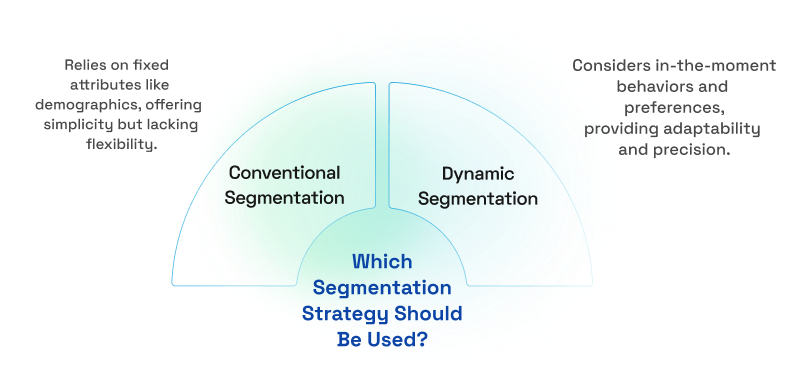
This shift highlights the growing importance of segmentation for businesses of all sizes. Whether you're a local retailer or a multinational corporation, understanding your audience is crucial to staying relevant and competitive.
The Evolution of Segmentation Methods
Historically, segmentation relied heavily on static data points, such as age brackets or income levels. These methods worked well when markets were predictable, and customer behaviours followed consistent patterns.
However, the modern consumer journey is anything but linear. Today’s customers engage with brands across multiple channels, often expecting personalized experiences at every touch-point.
This has driven a shift toward behavior-based and real-time segmentation models that reflect current actions and predict future needs.
Role of Technology in Modern Segmentation
Advances in technology have fuelled this evolution.
Big data, artificial intelligence (AI), and machine learning enable businesses to analyze vast datasets, uncover patterns, and segment customers more effectively.
Continuous data collection and analysis are now integral to segmentation and personalization strategies.
Whether through website analytics, social media interactions, or purchase histories, brands can gather and process real-time insights, creating a foundation for dynamic, responsive targeting.
Predictive Analytics in Customer Segmentation
Predictive analytics takes customer segmentation to the next level by moving from static descriptions of who your customers are to dynamic forecasts of what they’re likely to do. This forward-looking approach empowers brands to preemptively address potential challenges, such as customer churn, and uncover growth opportunities.
A leading telecom provider in India collaborated with Xerago to reduce customer churn through predictive analytics. By analyzing six months of historical data, we developed a churn prediction model using advanced algorithms. This enabled the identification of high-risk customers, who were then targeted with personalized retention strategies.
The results were impressive: the churn rate dropped by 25%, customer satisfaction scores rose by 40%, and the initiative was successfully scaled nationwide. This illustrates how predictive segmentation not only enhances retention but also drives long-term customer loyalty.
By integrating predictive insights into segmentation models, businesses can proactively engage their audience, improving both customer experience and operational efficiency.
Applying Predictive Analytics in Customer segmentation
Predictive analytics uses statistical algorithms, machine learning, and data modelling to forecast future outcomes based on historical data.
When applied to customer segmentation, it moves beyond merely describing current customer groups and starts predicting their future behaviours, preferences, and needs.
For instance, predictive models can identify customers likely to churn, anticipate future purchasing trends, or estimate the lifetime value of a particular segment. By leveraging these insights, businesses can act proactively, addressing potential issues or capitalizing on emerging opportunities.
Benefits of Predictive Analytics for Businesses
Predictive analytics helps businesses anticipate customer needs, enhance personalization, and maximize ROI.
- Anticipating Customer Needs: Brands can engage customers before they express a need, whether by recommending products they’ll likely purchase or offering timely incentives to prevent churn.
- Optimizing Resource Allocation: With predictions on which segments are most profitable, businesses can prioritize efforts where they’ll generate the highest return on investment (ROI).
- Enhancing Personalization: By understanding individual behaviours within segments, businesses can tailor messages, products, and services to match customer expectations more accurately.
Adaptive Models: Real-Time Customer Segmentation
Unlike traditional methods that analyze static data, adaptive models continuously update segments based on the latest customer actions. This approach allows businesses to respond immediately with personalized messaging, offers, or recommendations that align with a customer’s current preferences.
A prominent Malaysian banking institution partnered with Xerago to enhance its analytics capabilities and enable real-time customer segmentation. The bank restructured its Adobe Analytics framework to ensure accurate data tracking and integrated SAS Event Stream Processing for real-time insights.
By consolidating customer data into unified profiles, the bank was able to dynamically segment customers based on on-site behavior, location, and demographics. Real-time analytics powered adaptive campaigns that increased engagement rates by 35% and improved application conversion rates by 43%.
How Adaptive Models Work
Adaptive models build on the foundation of predictive analytics but add the capability to adjust dynamically as new data flows in.
These models continuously integrate customer actions - whether browsing behaviour, social media interactions, or recent purchases - into their calculations, ensuring segmentation evolves in real time.
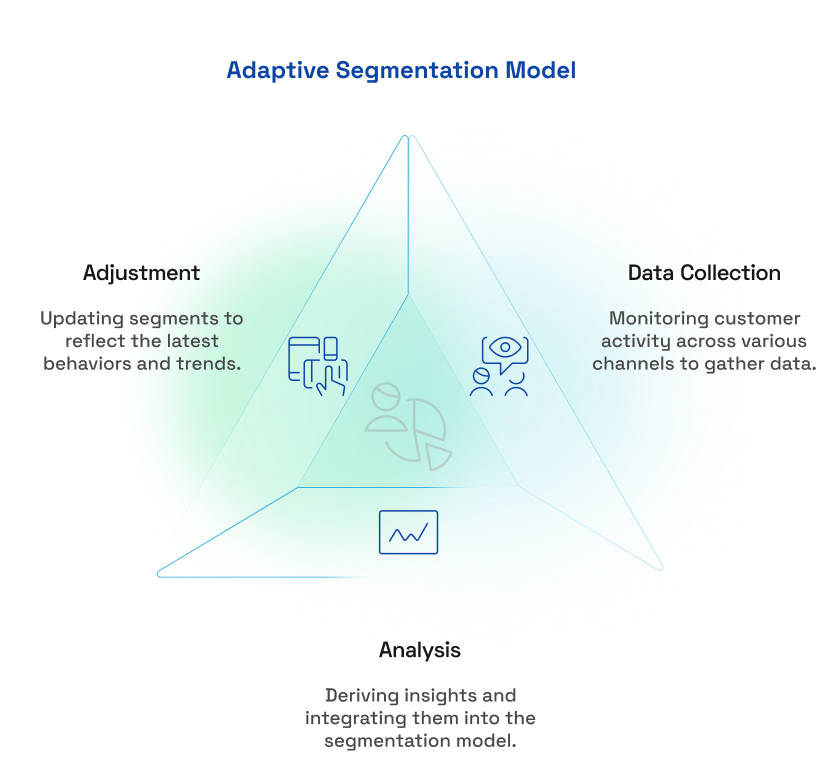
This dynamic process enables businesses to stay relevant, ensuring that their messaging and offers resonate with customers at any given moment.
3.2. Advantages of Adaptive Models over Static Segmentation
Adaptive models excel in today’s fast-paced market environment by providing:
- Real-Time Relevance: Unlike static segmentation, adaptive models capture shifts in customer behaviour as they happen, allowing businesses to respond immediately.
- Hyper-Personalization: These models enable brands to deliver tailored experiences, such as customized product recommendations or time-sensitive offers, based on what customers are doing right now.
- Resilience in Dynamic Markets: Adaptive models ensure segmentation remains effective even when market conditions change abruptly, such as during seasonal trends or unexpected disruptions.
For example, an online retailer using adaptive segmentation might notice a sudden spike in interest in winter coats due to a cold snap.
The model could immediately create a segment for “cold weather shoppers” and trigger relevant marketing campaigns. It can go a step further to create micro-segments within this group—for instance, identifying shoppers browsing premium brands versus those searching for budget-friendly options. The retailer could then deliver highly relevant recommendations, such as offering discounts to price-sensitive customers or showcasing exclusive collections to those seeking luxury items. This level of granularity ensures the messaging resonates deeply with each customer, increasing engagement and driving conversions.
Tools and Technologies for Predictive and Adaptive Segmentation
Achieving adaptive segmentation requires the right tools and technologies. Some essential components include:
- Customer Relationship Management (CRM) Systems: Modern CRMs equipped with AI can integrate data from multiple touch-points, enabling dynamic updates to customer profiles.
Examples: Salesforce, HubSpot, Zoho CRM - Customer Data Platforms (CDPs): CDPs centralize customer data from multiple sources, providing a single source of truth for segmentation. These platforms help businesses create unified customer profiles, making it easier to implement both predictive and adaptive segmentation strategies.
Examples: Segment, BlueConic, Amperity - AI and Machine Learning Platforms: These systems process large datasets quickly, identifying patterns and updating segmentation models continuously.
Examples: Google Cloud AI, IBM Watson, AWS Machine Learning - Automation Tools: Tools like marketing automation platforms help execute real-time campaigns based on updated segmentation insights.
Examples: Adobe Campaign, HCL Unica, MoEngage - Real-Time Analytics Platforms: These platforms enable businesses to track customer actions as they happen, allowing for instantaneous updates to segmentation models. Real-time analytics ensures that marketing efforts remain relevant and responsive.
Examples: Google Analytics 4, Mixpanel, Heap
When choosing tools, businesses should consider scalability, integration capabilities, and user-friendliness to ensure seamless adoption and long-term success.
Implementing Predictive and Adaptive Segmentation in Your Business
Predictive and adaptive segmentation offers a smarter, more responsive approach, but it requires thoughtful implementation. With the right plan, businesses can unlock the full potential of dynamic segmentation to enhance personalization, optimize resources, and drive better outcomes.
Steps to Transition from Static to Dynamic Models
Moving from traditional segmentation to dynamic, real-time models is a transformative process that demands careful planning and execution.
Here’s a detailed roadmap:
1. Establish Clear Objectives
Define the purpose of segmentation: Are you aiming to increase customer retention, improve upselling opportunities, or enhance acquisition strategies?
Set measurable goals such as increasing customer lifetime value (CLV), reducing churn, or boosting campaign ROI. These KPIs will act as benchmarks for the success of your new segmentation strategies.
Furthermore, decide whether your approach will involve broad, easily actionable segments or granular micro-segments. Often time, using high-level segments will deliver outcomes but going a step further to define micro-cohorts deliver precision targeting that resonates at a deeper level. Therefore, align your objectives, KPIs and approach to lay the groundwork for effective segmentation.
2. Centralize and Organize Data
Integrate Data Sources: Consolidate customer data from multiple touchpoints—CRM, CDP, web analytics, point-of-sale systems, and social media. Data silos not only slow down decision-making but also create incomplete views of the customer journey.
Determine if your data captures behavioral, transactional, and interactional insights. Many businesses focus heavily on demographics but fail to track crucial behavioral patterns, such as browsing history or in-app actions.
And, finally assess the accuracy and completeness of your current datasets so that it does not impact the reliability of your segmentation efforts.
3. Build and Train Predictive Models
Use Machine Learning Models to forecast customer behavior based on historical and real-time data. Algorithms such as decision trees, neural networks, or gradient boosting are commonly used to process large volumes of customer data and identify patterns. These models predict outcomes like purchase likelihood, churn risk, or upsell potential, helping businesses create highly targeted segments.
Include data points like purchase frequency, browsing history, engagement rates, and external factors such as seasonality. Effective predictive models rely on a mix of historical and real-time data. Key data points include:
- Purchase Frequency: Identifying customers who make frequent purchases versus occasional buyers.
- Browsing History: Understanding product categories or services customers explore but don’t purchase.
- Engagement Rates: Tracking interaction with emails, apps, or social media to gauge interest and intent.
- External Factors: Seasonality, economic trends, or weather patterns can provide valuable context for predictions. For example, seasonal spikes in certain product categories can influence segmentation for targeted campaigns.
Regularly update and refine these models to improve prediction accuracy. Use techniques like cross-validation to test model performance and ensure its outputs remain reliable.
4. Enable Adaptive Segmentation
Deploy AI-driven systems that can dynamically update segments as customer behaviors and attributes change. Use platforms equipped with AI and machine learning to automate the process of monitoring customer behavior and updating segmentation. Tools like Salesforce Einstein, Microsoft Dynamics, or custom-built AI models ensure segments are continuously refreshed without manual intervention.
Focus on real-time behavioral triggers, such as cart abandonment, new sign-ups, or interactions with specific campaigns. Adaptive segmentation thrives on identifying and acting on immediate customer actions. Examples include:
- Cart Abandonment: Flagging customers who leave items in their cart and triggering personalized follow-up messages.
- New Sign-Ups: Segmenting first-time customers for onboarding campaigns or tailored offers.
- Campaign Interactions: Identifying customers engaging with a specific email or ad campaign to refine follow-up strategies.
Moreover, adaptive models should integrate data from all customer touchpoints, including website activity, mobile app usage, in-store visits, and social media engagement. This ensures segmentation reflects the complete customer journey.
5. Combine Segmentation Approaches
A successful dynamic segmentation strategy often blends traditional, predictive, and adaptive methods to achieve comprehensive customer insights. Combining these approaches maximizes the value of each and ensures no critical aspect of customer behavior is overlooked.
- Use traditional segmentation (e.g., demographic or psychographic) as a base layer. Start with established categories like demographics, geographics, and psychographics to create broad audience groups
- Layer predictive insights like propensity scores and lifetime value rankings.
- Add adaptive attributes, such as real-time engagement and response patterns, to fine-tune customer groups.
- To ensure precision, implement rules to exclude irrelevant or low-priority audiences. For more insights, refer to segmentation exclude rules to ensure focused targeting while avoiding irrelevant segments.
Finally, dynamic segmentation isn’t a one-and-done process. Continuously refine your models based on performance insights, evolving market trends, and changing customer behaviours to maintain relevance and effectiveness.
The Future of Customer Segmentation
The future of customer segmentation is deeply tied to technological advancements and changing consumer expectations. Here are some key trends to watch:
Emerging Trends in Predictive and Adaptive Segmentation
- Integration of IoT and Voice Analytics: Devices like smart speakers and wearables are generating new streams of data. Brands can use these insights to refine segmentation based on how customers interact with technology in their daily lives.
- Social Listening and Sentiment Analysis: Real-time analysis of social media conversations will help businesses identify emerging customer needs and segment audiences based on attitudes and sentiments.
- Cross-Industry Applications: While segmentation is traditionally linked to retail and marketing, industries like healthcare and finance are adopting dynamic models to deliver better services and outcomes.
Preparing for the Next Decade
To stay competitive, businesses must adopt an agile mindset when it comes to customer segmentation. Here’s what to focus on:
- Invest in Agility: Markets and technologies evolve rapidly, so businesses need to ensure their segmentation strategies can adapt quickly.
- Embrace Collaboration: Encourage collaboration across departments like marketing, sales, and customer support to create unified, data-driven approaches.
- Focus on Innovation: Be ready to experiment with emerging technologies and techniques to stay ahead of the curve.
By doing so, businesses will be well-positioned to meet the demands of a future where customers expect seamless, personalized, and dynamic interactions with the brands they choose.
Conclusion
Customer segmentation has evolved from a static framework to a dynamic, real-time strategy powered by predictive and adaptive analytics.
These advanced models enable businesses to anticipate customer needs, adapt to changing behaviours, and deliver hyper-personalized experiences that drive engagement and loyalty.
The future of segmentation belongs to businesses willing to innovate and focus on creating meaningful, ethical connections with their audiences.
Now is the time to act - empower your team, leverage data, and redefine your approach to customer engagement.